‘No cases against women sent to military courts’



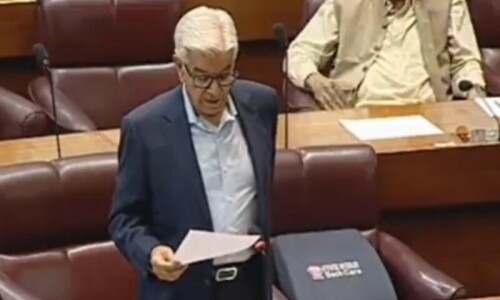
ISLAMABAD: Law Minister Azam Nazeer Tarar on Wednesday said that till date, no case against any woman involved in the May 9 violence following the arrest of PTI chairman Imran Khan, has been sent to the military courts.
The minimum requirements as required under different international laws, especially Article 14 of the International Covenants for Civil and Political Rights 1966 (ICCPR) that deals with fair trial, will be ensured during the prosecution of the accused in the military courts, the law minister said.
As the international laws suggest, the minister also explained that the accused should be given the right to appoint their counsel of choice to defend them in the case. Likewise, they must have the right to adduce the defence evidence against them and should have access to the record or material being used by the defence against the accused as well as the right to judicial review against the decision of the trial court.
While talking to media at the Supreme Court building, the law minister said that the decision on whether a case should be tried by a military court or a civilian court is not a matter of choice for the federal government or any other department or relevant authority, but is determined by the operation of the law.
Law minister says around 74 cases forwarded for trial under army act
“It depends upon the material and evidence against the accused,” he said, adding that the decision regarding which case should be referred to the military court has been done after a proper scrutiny of the material sent by the JAG (Judge Advocate General) Branch — a legal wing of the military — by the judge of the anti-terrorism court concerned in view of the incriminating evidence against the accused.
The minister said that till date 74 cases had been sent to the military courts, but no case against any woman had been referred to such courts.
An informed source said by using the good offices of the Foreign Office, the government was also trying to engage the international community to allay the apprehensions being expressed by members of the civil society as well as the international community regarding alleged violations of the fundamental rights and arbitrary detentions.
According to media reports, the United Nations High Commissioner for Human Rights recently expressed concerns over the issue. The Amnesty International has also stated that trying civilians in military courts is contrary to International Human Rights Law, violating the right to a fair trial guaranteed under Article 14 of the ICCPR, which guarantees the right to a trial before competent, independent and impartial courts established by the law.
Under its General Comment on Article 14 of the ICCPR, the UN Human Rights Committee has affirmed that “fundamental principles of fair trial” are non-derogable. Pakistan ratified the ICCPR in 2010 and is bound by these international obligations.
Published in Dawn, June 15th, 2023