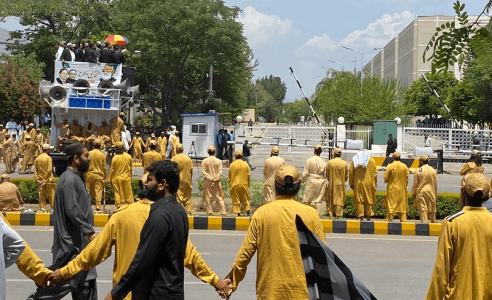
IT was a strange sight to behold. Islamabad’s Red Zone, one of the most sensitive and jealously guarded areas of the capital city, was besieged yesterday by hordes of stick-wielding men without so much as a warning shot being fired by the state.
Islamabad Police — usually so zealous and trigger-happy when facing down protesters — stood by sedately as individuals backed by the sitting government first scaled and then broke through the gates leading to the protected area.
Section 144 of the Code of Criminal Procedure — which prohibits the gathering of four or more persons in an area — was still in effect in the capital, but for the first time, it seemed the state had no interest in seeing it enforced.
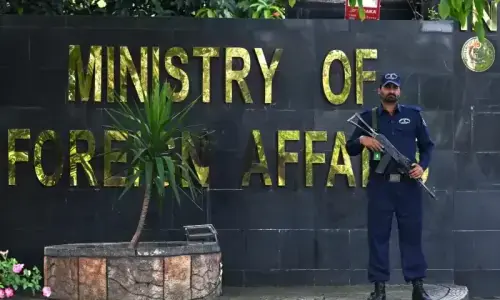
The interior minister, otherwise quick to appear on TV screens whenever needed to ‘justify’ all manner of highhanded means to ‘maintain public order’, was nowhere to be seen. To top it off, the state quietly restored access to social media after days of closure, seemingly to amplify the ‘reach’ of the event.
While our ruling classes are no strangers to the ‘rules for thee and not for me’ style of governance, yesterday’s example was more than a little egregious.
The government is currently in violation of the Constitution over its refusal to hold due elections to the KP and Punjab assemblies, yet it expects the Supreme Court to play by the rules.
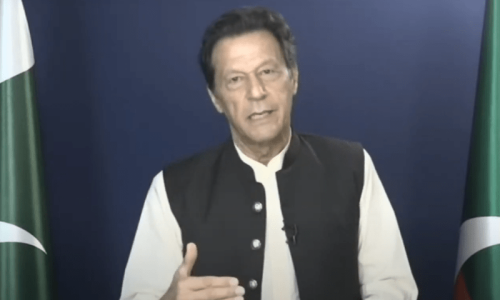
It complains that the judiciary is ‘protecting’ Imran Khan, even as it has the executive branch of the state — which ought to have been enforcing the law yesterday, without prejudice as to who had shown up to protest — acting in complete subservience to it.
Elsewhere, inside the highest court of the land, the elections implementation bench decided to give ‘negotiations’ another shot. It was clear from reports of the proceedings that the judges were acutely aware of the developments unfolding outside the Supreme Court’s walls.
While talks are, indeed, the best solution to Pakistan’s festering political crisis, there is very little hope that they can accomplish much in this poisoned atmosphere.
Instead, the chief justice’s decision to impose another ‘second chance’ on politicians indicates that he may have come to the realisation that his court should not have gotten tangled up in a fight that it cannot control.
With the government knocking loudly on its gates, it may not be easy for the court to settle the matter — unless a full-court bench is formed to break the current deadlock.
With some actors looking to divide and ‘conquer’ the Supreme Court, it is important for the top court now to show that it is united within. The breakthrough the country needs might be in the chief justice’s hands; will he deliver it?
Published in Dawn, May 16th, 2023