THE gloves are off. If the government can ‘reject’ the Supreme Court’s verdicts, defy its orders and call into question its integrity, Chief Justice Umar Ata Bandial, too, can take the fight to the PDM if he so pleases.
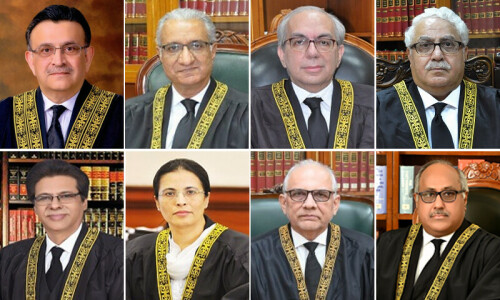
At least that’s the message that appears to have been sent when the CJP formed an eight-member bench to hear a petition questioning the constitutionality of the Supreme Court (Practice and Procedure) Bill passed recently by parliament.
That same bench on Thursday unanimously decided that while it was too early to strike down the law, it could issue an ‘anticipatory injunction’ preventing it from taking effect.
“The moment that the Bill receives the assent of the President or (as the case may be), it is deemed that such assent has been given, then from that very moment onwards and till further orders, the Act that comes into being shall not have, take or be given any effect nor be acted upon in any manner,” the eight judges ordered yesterday.
Chief Justice Bandial has recently faced much criticism for being ‘too arbitrary’ when forming benches that are burdened with deciding important legal matters. These benches, the critics believe, have ruled ‘too regularly’ in favour of the PDM government’s opponents.
Justice Bandial seems to have been quite cognisant of this line of criticism: the benches announced for this week’s hearings had caused quite a stir as the CJP was said to have made a conscious effort to have differing perspectives represented on each bench.
However, when the bench asked to hear the petitions against the Supreme Court (Practice and Procedure) Bill was announced on Wednesday, it left little doubt that Justice Bandial was keen to underline his power and authority. The number was as significant as the names of the judges: clearly, he had the support of the Supreme Court’s majority.
Separately, the chief justice also demonstrated that he could cut out the federal government and approach the executive directly on the Punjab elections matter. Key state officials have been summoned to meet him today in chambers.
There is speculation that he may direct the officials to implement the orders of the Supreme Court regarding the provision of resources required by the ECP. There is also the possibility of the federal government being charged with contempt for ‘disobeying’ the apex court’s April 10 deadline to hand over Rs21bn to the ECP for elections.
With the chief justice seemingly unapologetic about resorting to the vast powers vested in his office, the federal government’s stand-off with the Supreme Court is likely to take an uglier turn. The window for finding an amicable way out of Pakistan’s crisis is closing fast. Will the key stakeholders still refuse to act? Or will our institutions continue climbing the escalation ladder?
Published in Dawn, April 14th, 2023