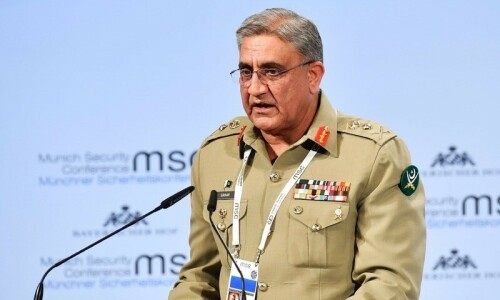
THE elephant in the room was the army’s role in politics, and the response was predictable. Neutral is the way it is going to be, so it is claimed. Before that came up, however, newly appointed DG ISPR Maj Gen Ahmed Sharif Chaudhry in his maiden presser talked at length about security-related issues. Among these, he listed the military’s successes in anti-terror operations, saying that the army and LEAs had carried out 8,269 intelligence-based operations during 2022 in which 1,378 suspected terrorists were taken into custody and 157 were killed.
Significantly, given the public uproar over what had been a plan to ‘mainstream’ TTP militants in KP’s tribal districts, he distanced his institution from the previous government’s initiative of holding talks with the banned group. Gen Chaudhry also spoke about the evolving militant landscape following the US exit from Afghanistan and said that TTP and Baloch insurgents were working together to sabotage peace in Balochistan and KP.
The question-and-answer session provided the opening for the DG ISPR to say that relations between a sitting government and the army were apolitical but constitutional in nature and that the army did not support the ideology of any party and respected all parties. What was said should be a statement of the obvious in any democracy. But when former army chief Gen Qamar Bajwa admitted that the army has been meddling in politics for almost the entirety of Pakistan’s existence, he was articulating what everyone had known for a long time: the military had either been ruling directly or pulling the strings from behind the scenes, making and breaking governments, manipulating poll results, engineering alliances, etc.
However, it will take much more than assertions to convince a sceptical public of the security establishment’s newfound neutrality, a consequence of the unprecedented criticism it was exposed to after the unravelling of its hybrid experiment.
Unfortunately, a number of developments have strengthened suspicions of continued interference. The cascade of audio leaks, for example, is obviously calculated to compromise certain individuals and shape the political landscape in a particular way. Everyone is well aware of which hidden hand has the most advanced capabilities for electronic surveillance. Other moves such as the ‘reunification’ of the various MQM factions and the PSP — which could impact politics in Karachi — under the stewardship of a recent, lateral entrant in the MQM ranks, also seems forced rather than organic.
So unconvincing is this ‘apoliticality’ that even the prospect of martial law has not receded. On the contrary, even a seasoned politician such as Shahid Khaqan Abbasi recently warned that the prevailing situation in the country is ripe for a military intervention. The army will have to walk the walk, not only talk the talk.
Published in Dawn, April 27th, 2023