IT was around 10pm and customers were increasing in number. But the shop owner had run out of the available stocks of delicious rabri, or sweet condensed cream, on the second day of Eidul Fitr.
“Can we have a small quantity of it [rabri],” Hazrat Ali, a second year student from Peshawar, inquires from shop owner Naveed Shaikh. He, however, apologises.
“I can’t meet demand on occasions like Eid for a variety of reasons,” says Naveed while telling workers to shutter the shop to avoid hassle. “It is difficult to meet commitments. Constraints ranging from issues of milk supplies to load management of natural gas leave me vulnerable. I have to sell fresh product because it is the key to success.”
Located in the narrow passages of old city’s famous 18th century Pucca Qilla area, the Haji Rabri Wala has become the identity of Hyderabad the world over since the independence.
Naveed’s great grandfather, Haji Basheeruddin, started the shop here in 1948 after migrating from Rewari in India to the newly-born state of Pakistan. Bearded Haji’s turban-wearing photo hangs in a corner of the shop. As the Haji’s fourth generation, Naveed is in the saddle to run the product which has completed its platinum jubilee. Basheeruddin had brought the recipe from India and started it here from scratch on a small-scale.
Haji Rabri Wala has been Hyderabad’s identity since long
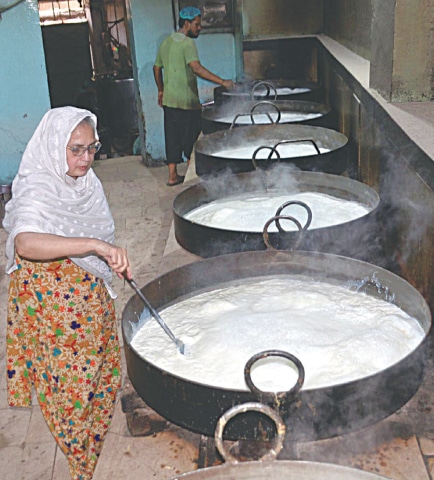
When Naveed’s father died in late ‘80s and Basheerudin became too old, his mother Naseem Bano began looking after the business. Now in advance age she still looks energetic and keen to look after the rabri-making process in the backyard of the shop.
Abba jee [her grandfather-in-law Basheeruddin] had bought a small space from a Hindu for Rs350,” she says as she started sharing the story to me.
“Taste, cleanliness and quality is our hallmark that can’t be compromised or undermined. We produce limited quantity with quality,” she insists and expresses satisfaction that things remain normal as was case in Basheeruddin’s time.
She sheds light how her family had gone through ups and downs following the death of Nooruddin and then Noor’s father, Hakeemuddin. Nonagenarian Basheer died in 1990.
She recalled how Basheeruddin’s relatives wrote to that Hindu property owner to take back his property which had then become a known business point. “The man did return from India but had to return empty-handed as Basheeruddin refused to return the property,” she says and ascribes business success to the blessings of a spiritual figure, Baba Salahuddin, for Basheeruddin.
Ruled Card — a principal property document in revenue record — featured name of one Gagumal as the owner of the space/property number 841 and this number is there on the trademark registration. Basheeruddin’s name appeared on the card — shared by Naveed — on Feb 1, 1975, with a sum of Rs15,000. Haji and his sons purchased more properties to be amalgamated to raise the present shop-cum-residential building. But Naveed didn’t shift the business from there to a more developed and urbanised part of the city even after seven decades.
The rabri — plain, pistachio flavoured and sugar free — is something distinctive among sweetmeats. It was initially sold in earthen tumblers, which makes its more unique. The tumblers kept its quality and aroma intact, but now plastic pots and tin packs are used to enable customers carry it easily.
Naveed’s widowed mother grappled with issues but didn’t give up.
“My sons were minors. So, family members of my in-laws started looking after work although not without purpose. Time came and my sons eventually took up the reins of the business,” says Bano smilingly. “I didn’t leave house till Naveed and his brothers attained adulthood.”
Naveed was poised to make his forefather’s business a success story. “Had amma [mother] left house after father’s death and other conditions she would have perhaps lost her claim to the business and we would have been nowhere. My father must have given new dimensions to the work he had inherited from his grandfather had he not died that early,” he says.
Bano reminisces about how 40kg of milk — five kg in each frying pan — was used to produce 13kg of rabri initially sans proper cooling facility then. “We used to have plenty of water underneath rabri carrying trays for manual chilling while using piece of muslin to cover the product.”
But today her son uses 1,600kg of milk to make 400kg of rabri in a day. “On occasions like I need 3,000kg of milk to have around 700kg or 800kg of rabri,” adds Naveed.
Rabri becomes ready for sale after multiple stages of boiling and chilling. Workers boil milk at unusually high temperature until, for example, 10kg milk transforms into 1.5kg rabri. After having mixed with sugar, which turned it yellow, lacchhay [cream’s layers] are collected in huge frying pans and frozen before sale. Naveed has increased the number of pans and established a cold storage for cooling.
As business management graduate from Dadu, he intends to add new dimension to the business he inherited from his ancestors. Since started overseeing the business, he went for transformation, from a conventional approach to e-trade, to market his brand nationally and internationally to keep pace with new trends.
Whatsapp messages for orders from abroad are regular traffic on his smartphone. “One Athar Shaikh from Texas placed orders for 60-70kg, which have been met in the last one week ahead of Eid,” he tells me.
Likewise, Iftikhar from London had placed an order for 33kg rabri in piecemeal.
“A US client puts my product on Facebook page for 1kg tin pack for approximately $20-$25 in Houston after buying it for Rs1,200,” he says.
However, there is a challenge.
“Many sell rabri with ours name at the railway station though I have no second branch other than Karachi. Complaints to the authorities fall on a deaf ear even though I got a trade mark registered a decade back,” he remarks.
Naveed aims to make his brand known globally. He is planning business abroad and grooming his son, Aurangzeb, for this venture once he completes business education and gets the degree.
Published in Dawn, April 25th, 2023