ISLAMABAD: Short-term inflation, based on the Sensitive Price Index (SPI), spiked to an unprecedented 47.23 per cent year-on-year for the combined income group for the week ending April 19, according to data released by the Pakistan Bureau of Statistics (PBS) on Friday.
The year-on-year SPI has been steadily on the rise since August last year and remained mostly above 40pc. It rose to 42.31pc on Aug 18 last year, followed by 45.5pc on Sept 1 that year and 46.65pc during the week ending March 22 this year.
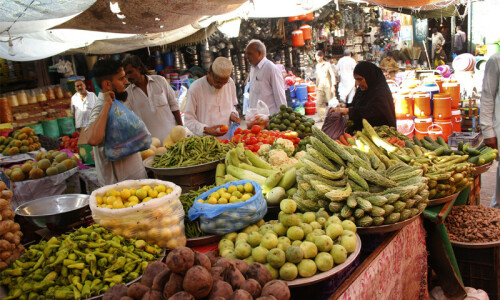
On a week-on-week basis, inflation was 0.51pc for the period under review, with food items getting costlier, particularly potatoes, tea, bread, chicken, LPG and petrol.
The SPI has mostly increased since the start of Ramazan because of record rupee devaluation, costly petrol prices, a hike in sales tax and higher electricity charges. One of the factors for the increase in prices of perishable products is due to the higher transportation charges.
Record rupee devaluation, higher fuel and electricity rates blamed for SPI hike
The only tool the government has used so far to tame inflation was a steady increase in the interest rates which rose to 21pc — a record level in the country’s history.
Economists believe that the current high prices were due to several factors, including the supply side’s highest-ever transportation cost, while the government’s focus is only on curtailing the money supply to the market which has so far not yielded desired results.
During the week under review, the items whose prices increased the most over the same week a year ago included wheat flour (143.88pc), gas charges for Q1 (108.38pc), tea Lipton (104.28pc), diesel (102.84pc), potatoes (98.74pc), bananas (98.42pc), eggs (97.80pc), petrol (87.81pc), rice basmati broken (87.30pc), rice Irri-6/9 (83.52pc), pulse moong (68.94pc), bread (59.22pc) and pulse mash (58.35pc).
On a week-on-week basis, out of the 51 items in the SPI basket, the prices of 29 items soared, those of eight items decreased, and those of 14 items remained unchanged.
The biggest change was observed in the prices of potatoes (3.79pc), tea Lipton (3.61pc), gur (3.40pc), bread (2.48pc), chicken (2pc), bananas (1.68pc), rice basmati broken (1.54pc) and rice Irri-6/9 (1.22pc), LPG (4.75pc), petrol (3.67pc) and matchbox (2.51pc).
The products whose prices saw the highest decline over the previous week were tomatoes (13.11pc), onions (4.62pc), garlic (3.59pc), sugar (1.52pc), wheat flour (0.93pc), mustard oil (0.56pc), cigarettes (0.26pc) and pulse gram (0.22pc).
The government has been taking strict measures — hikes in fuel and power tariffs, withdrawal of subsidies, market-based exchange rate and higher taxation — under the International Monetary Fund (IMF) programme to generate revenue for bridging the fiscal deficit, which may result in slow economic growth and higher inflation in the coming months.
However, the government has yet to unlock the IMF programme despite taking all inflationary and austerity measures.
The increase in the SBP policy rate to 20pc, sales tax from 17pc to 18pc on most items and 25pc on more than 800 imported food and non-food items will further increase the retail prices of consumer goods.
Published in Dawn, April 22nd, 2023