0
0

A bill seeking to curtail the chief justice of Pakistan’s (CJP) powers to take suo motu notices and constituting benches became a law on Friday, despite a Supreme Court order halting its implementation.
The development was shared by the National Assembly’s official Twitter account.
“Supreme Court (Practice and Procedure) Act, 2023 of the Majlis-i-Shoora (Parliament) is deemed to have been assented by the President […] under clause (2) of Article 75 of the Constitution of Islamic Republic of Pakistan. It is hereby published for general information,” the tweet said.
It should be noted that last week the top court, in a pre-emptive strike, passed an order barring the government from enforcing the then-bill when it became law.
“The moment that the bill receives the assent of the president or it is deemed that such assent has been given, then from that very moment onwards and till further orders, the act that comes into being shall not have, take or be given any effect nor be acted upon in any manner,” said an interim order issued by an eight-member bench.
The legislation deprives the office of the CJP of powers to take suo motu notice in an individual capacity and giving the right to appeal in all suo motu cases with retrospective effect.
The law states that a three-member bench, comprising the CJP and the two senior-most judges of the apex court, will decide whether or not to take up a matter suo motu. Previously, this was solely the prerogative of the CJP.
The law also states that every cause, matter, or appeal before the apex court would be heard and disposed of by a bench, constituted by a committee made up of the chief justice and the two senior-most judges.
The legislation also includes the right to file an appeal within 30 days of the judgement in a suo motu case and that any case involving constitutional interpretation will not have a bench of fewer than five judges.
It seeks to allow former prime minister Nawaz Sharif and other parliamentarians disqualified by the Supreme Court under suo motu powers (such as Jahangir Tareen) to appeal their disqualification within 30 days of the law’s enactment.
Back and forth
Initially, the bill was approved by the federal cabinet on March 28 and then passed by both houses of Parliament — the National Assembly and Senate — only for President Arif Alvi to refuse to sign it into law with the observation that it travelled “beyond the competence of Parliament”.
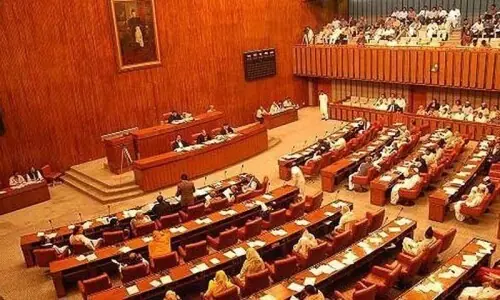
However, a joint session of Parliament passed it again on April 10 with certain amendments amid a noisy protest by PTI lawmakers.
It was then again referred to the president for his assent. As per the Constitution, if the bill was not signed by him within 10 days, his assent would have been deemed granted.
However, three days after the passing of the bill by the joint Parliament session, an eight-member bench of the Supreme Court (SC), including CJP Umar Ata Bandial, issued an order that barred the government from implementing the bill after it becomes a law.
Meanwhile, on April 19, the president, for a second time, had refused to give his assent for the bill and sent it back to Parliament, maintaining that the matter was subjudice — in court.