THE breadlines are growing, highlighting people’s desperation as making ends meet under conditions of galloping inflation is becoming increasingly difficult. Unfortunately, public and private efforts to get food to the deserving have been hampered by mismanagement, as was witnessed during Friday’s tragic stampede in Karachi.
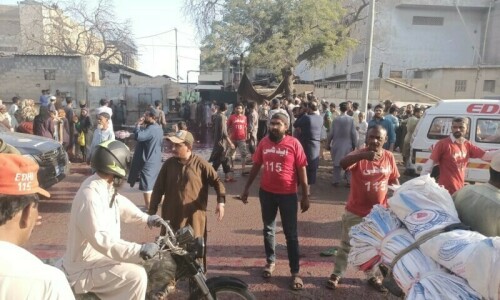
Hundreds of women, accompanied by children, had gathered at an industrial unit in the city’s SITE area to collect food aid and zakat being distributed by the factory’s owner. Panic ensued when staffers reportedly closed the doors, resulting in the death of at least 12 people. Both the local administration and police say they were not informed of the charity drive by the organisers.
Regrettably, the state’s efforts have hardly been better organised. A number of people have died at official free flour distribution events in KP and Punjab, while trucks have been looted in KP. In several cases, people have complained that flour is either being given to those with ‘connections’, or to those who grease the palms of officials.
Moreover, the sight of women and the elderly standing in long queues for hours to secure a sack or two of flour, and being jostled and manhandled in the process, is a sad one. And if the finance ministry’s prognostications are anything to go by, people’s misery is unlikely to end soon, as even higher prices are round the corner.
As the ministry noted on Friday, the “second-round effect” of policy decisions was likely to push up record inflation further. Factors contributing to high prices include supply and demand issues of essentials, a plummeting rupee, and high fuel costs.
With inflation unlikely to ease in the near future, efforts need to be made by the state and others with means to help the poor as well as the ‘new poor’ to get by with dignity. Better organisation is the key to preventing the tragic deaths and injuries that have been occurring at charity distribution points. For the state, the distribution of food aid or cash needs to be streamlined and transparent. Inviting hundreds of people to stand in line is obviously not the most efficient way to get help to people.
Established charities in the country have well-developed networks and systems in place, and the state needs to replicate these to prevent chaos in the distribution of food. For example, people can be asked to register on the phone for help, and then be called to spacious, well-manned distribution points to collect cash or food.
Meanwhile, a large number of people many not be comfortable publicly collecting handouts, so efforts need to be made to provide them with help at their doorstep. Finally, private persons distributing charity in large numbers need to alert the local authorities, and follow SOPs to ensure there are no mishaps.
Published in Dawn, April 2nd, 2023