Govt shares petroleum pricing strategy for programme aimed at providing relief to the poor


 0
0


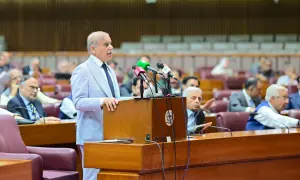
The government on Wednesday shared its strategy for the recently-announced fuel relief programme, which is to be implemented in three phases and will “provide a relief of up to Rs50 per litre to the poor”.
The scheme’s announcement had come days after the government increased the prices of all petroleum products — except the insignificant light diesel oil — by up to Rs13 per litre for the next fortnight.
In a report that details the pricing strategy behind the Prime Minister’s Petroleum Relief Programme, the government said it has developed a two-tier pricing programme that would provide relief to two-wheelers (motorcycles), three-wheelers (rickshaws) and small vehicles by dividing the consumers into the categories of “poor” and “rich”.
The programme will target roughly 20 million motorcycles and rickshaws (with a capping of 21 litres of fuel) & 1.36m small vehicles (with a capping of 30 litres of fuel) currently active across Pakistan, the report states.
The government has used information from surveys and car sales data to estimate the number of vehicles currently active.
Using differential pricing wherein the base price of fuel is assumed to be Rs300 per litre, the “poor” will be provided relief of up to Rs50 by charging the “rich” an additional Rs102 per litre.
The resulting assumed prices would be Rs250 for the “poor” and Rs352 for the “rich”.

The report further says that the programme will use two models for its implementation — an e-discount through OTP and a “fuel card”.
The implementation will be done in three phases with the first being an increment in the base fuel price (Rs300) of Rs75 — setting the new price without relief at Rs375 — and the collection of money in an escrow account.
In the second phase, the government will “use two different registration mechanisms to enrol the beneficiaries”.
One mechanism would involve data being uploaded by the Vehicle Registration Authority to the National Database and Registration Authority (Nadra) while the other would have the consumer register their vehicle via SMS.
In the final phase, the discount will be dispersed to the beneficiary after they have registered on the relevant registration portal and a transaction has been processed at the fuel station.
The Ministry of Energy (Petroleum Division) will supervise the roles and responsibilities of various actors involved in the plan — including Nadra, the Oil & Gas Regulatory Authority, oil marketing companies and the National Bank of Pakistan.
Fuel relief programme plan
While chairing a meeting in Lahore on March 19, Prime Minister Shehbaz Sharif had said that low-income segments — consisting of consumers with motorcycles, rickshaws, 800cc cars and other small vehicles — would be given a subsidy of Rs50 per litre under the petroleum relief package.
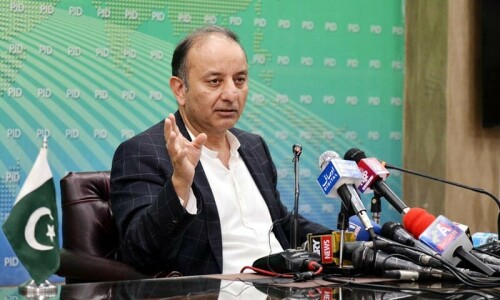
Although a day later State Minister for Petroleum Dr Musadik Malik had announced the government will provide petrol at “Rs100 less than the official rate”, the strategy shared today maintains the premier’s announcement of a “relief of up to Rs50 per litre”.
It is pertinent to mention that the International Monetary Fund (IMF) — which has mandated reforms and measures on Pakistan to revive a stalled $6.5 billion IMF loan programme — has not yet been consulted on the government’s recent move.
Esther Perez Ruiz, the IMF’s resident representative for Pakistan, said that the lender’s staff are “seeking greater details on the scheme”.