Survivors plucked from rooftops as New Zealand cyclone kills four



Military helicopters winched stranded storm survivors to safety in New Zealand on Wednesday after Cyclone Gabrielle killed four people and displaced 10,500 more.
With the storm now fading into the South Pacific, rescue teams have finally reached regions cut off by days of torrential rain and gale-force winds.
The New Zealand military deployed three NH90 helicopters on reconnaissance and rescue flights to the hard-hit Hawke’s Bay area, finding families, pets and workmates clustered on sodden zinc rooftops — surrounded by a sea of murky debris-filled floodwater.
“In some cases, flood waters were up to the second storey of homes where people were being rescued,” a military spokesperson said.
The disaster has severed roads, collapsed houses and cut power across a swathe of New Zealand’s North Island: home to more than three-quarters of the country’s five million residents.
The human toll continues to rise. Police said the body of a child was found in Eksdale on the remote east coast after the youngster was “believed to have been caught in rising flood water”.
Emergency Management Minister Kieran McAnulty said three other bodies had also been recovered from storm-hit areas.
They included a woman killed when her house was crushed by a landslip in Hawke’s Bay and a victim believed to be a volunteer firefighter trapped by a collapsing home.
About 10,500 people have been displaced and 140,000 are still without power, according to McAnulty.
He hailed the “phenomenal” effort of rescue workers and military personnel who plucked “roughly 300 people from rooftops” in Hawke’s Bay — a sprawling expanse of lush farmland, rugged mountains and hard-to-reach towns.
He said a group of 60 people were rescued from one large building marooned by floodwaters.
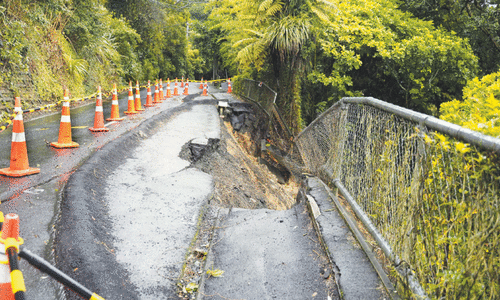
Aerial images showed a once-bucolic landscape riven with torrents of floodwater, latticed with crumbling roads and scarred by massive landslides.
“There’s still gaps in our knowledge. Some areas haven’t had communications for a couple of days and we know there’s a shortage of food and water,” McAnulty told radio station Newstalk ZB.
‘The long haul’
New Zealand faces a months-long effort to fix damaged roads, homes, and bridges.
Authorities on Tuesday announced a national state of emergency for only the third time in the country’s history, after the 2019 Christchurch attacks and the Covid-19 pandemic.
“This is a significant disaster which is going to take many weeks for those areas affected to recover,” said McAnulty. “We are in this for the long haul.”
Cyclone Gabrielle formed off the northeastern coast of Australia in the Coral Sea on February 8, before barrelling across the South Pacific.
It bore down on New Zealand’s northern coast on Sunday, bringing gusts of 140 kilometres (87 miles) an hour.
Over the next 24 hours, coastal communities were doused with 20 centimetres (almost eight inches) of rain and pounded by 11-metre (36-foot) waves.
Many parts of northern New Zealand were already waterlogged when Cyclone Gabrielle hit, having been drenched by record rainfall two weeks ago.
The national MetService said Auckland Airport received almost half its annual average rainfall in the past 45 days.
Scientists say Cyclone Gabrielle had fed off unusually warm seas, driven by a combination of climate change and La Nina weather patterns.
The storm is now hundreds of kilometres to the east of New Zealand, with wind speeds dropping rapidly.