Many quake victims go hungry as winter hampers aid efforts



• Survivors spend night in hospitals, mosques and public buildings
• Snow storms adding to the woes of displaced, rendering roads impassable
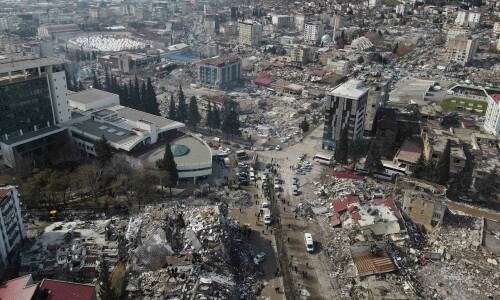
SANLIURFA: In the Turkish city of Sanliurfa, survivors of the massive quake that has wreaked death, destruction and havoc on the region face an invisible but powerful threat — hunger.
As the morning sun illuminates the sky, Sanliurfa’s cracked streets look empty. The mercury is only just above freezing, but it feels much colder.
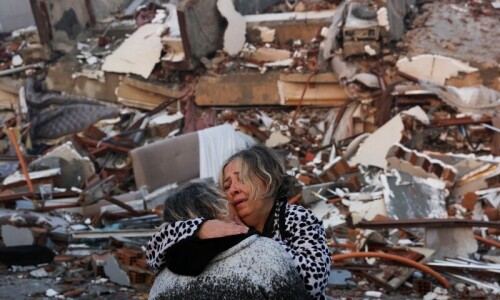
Like their neighbours in the other nine provinces hit by Monday’s quake and its frightening aftershocks, the people of Sanliurfa are focused on basic survival.
Dozens of Sanliurfa families found refuge in the imposing Hilton hotel’s ground floor.
Early on Tuesday, most of the parents huddling with their children have not slept a wink.
“We arrived here at 3pm yesterday, the hotel gave us soup in the evening, but the night has passed. We’re hungry, and the children too,” said Imam Caglar, 42.

“The bakeries will be closed today, I don’t know how we will find bread,” the father of three said.
It’s out of the question to go fetch food from his flat, located a few streets away, because of the danger that the building might suddenly crumble.
“We live on the first floor out of three, we’re too scared to return,” he says, shaking his head. “Our building is not safe at all.”
Winter hampers response
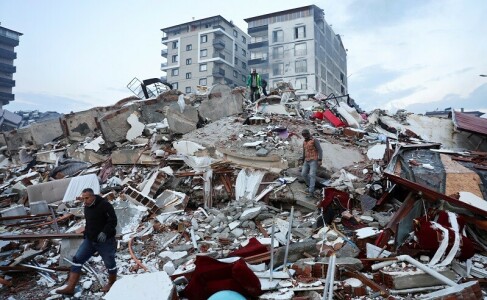
The Turkish government is scrambling to house people forced into the street after their homes either collapsed or were too risky to stay in because of the aftershocks.
Hundreds of thousands spent the night in dormitories, schools, mosques and other public buildings, while others sheltered in hotels that opened their doors for free.
Supplying them with food and other basic aid has been a challenge.
A winter storm has made the region’s roads, some of them heavily damaged by the tremors, nearly impassable. Many local airports are shut, their runways in need of repair.
“We had a small bowl of soup, that’s not enough,” says Mehmet Cilde, 56, a father of six.
He hopes that the local municipality will eventually provide food. But, he admits, “we have no information, nothing”.
‘Nothing but blankets’
The situation is even more dire for Filiz Cifci.
She missed the soup distribution on Monday evening, further along the street from the Hilton hotel.
Cifci and her three children, who fled their home on Monday before dawn with only their three blankets and phones, preferred to skip a meal than wait in the wind and cold rain.
“We only had tea and coffee yesterday evening, nothing else,” she said, in a headscarf and purple tunic.
She doesn’t know if her children will have enough to eat in the coming days.
“For now we have nothing but our blankets,” she said.
She paused, then added: “At least here, the water is drinkable.”
Published in Dawn, February 8th, 2023