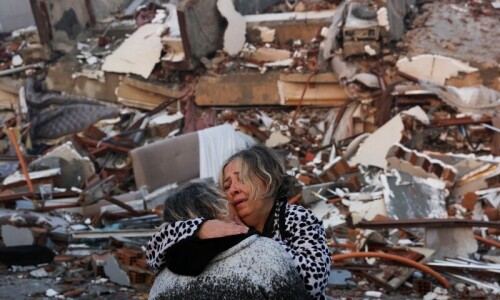
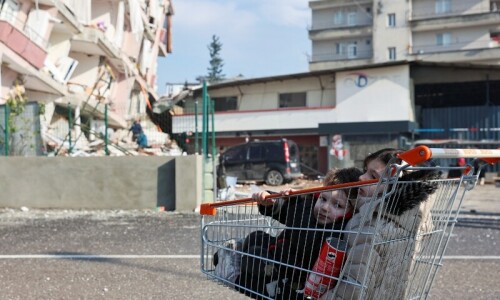
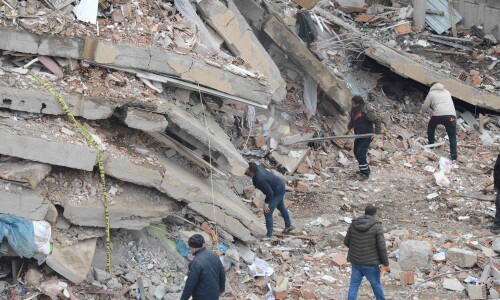
THE loss of thousands of lives in a devastating earthquake that struck Turkiye and neighbouring Syria early on Monday has cast a dark pall over this week. As rescuers make frantic efforts to retrieve survivors from under the rubble of thousands of collapsed buildings, the images and reports pouring in from the affected areas tell a story of grave human tragedy.
The earthquake was the most powerful in the world recorded by the US Geological Survey since August 2021 and the deadliest in Turkiye since 1999. Following the Monday quake, there have also been multiple smaller earthquakes and aftershocks of varying magnitude.
As the people of Turkiye and Syria continue searching for their loved ones amidst the destruction caused by this natural disaster, Pakistan stands with them in this difficult hour.
Islamabad despatched the first relief flight to Turkiye on the night of Feb 6 with rescue experts, sniffer dogs, search equipment, a medical team comprising army doctors, nursing staff and technicians, and a 30-bedded mobile hospital, tents and blankets.
Another 51-member team was dispatched to Istanbul on Tuesday, comprising doctors, paramedics, and rescue workers.
Another plane carrying medicines and other essential items is also expected to fly out soon, according to the prime minister. It is hoped that Pakistan continues to send as many personnel and relief goods as needed to both countries. Syria, in particular, has been devastated by more than a decade of war.
It is likely to have a much greater need for help getting back up on its feet, and Pakistan has a moral responsibility to offer and ensure as much assistance as possible.
It is unclear at the moment if the prime minister’s relief fund for Turkiye, to which the federal cabinet has also contributed a month’s salary, is to be utilised to assist Syria as well. If not, this should be rectified at the earliest.
If need be, groups of volunteers and local NGOs who are familiar with disaster response work can also be assisted in travelling to the affected regions to help in relief efforts.
However, such arrangements must be made in close coordination with the governments of Syria and Turkiye to avoid disturbing their own rescue and relief efforts.
The weather in the affected region has been particularly unrelenting, with snow, forbidding cold and rainfall making the job of extricating survivors from collapsed buildings much more difficult than it would otherwise have been.
Snowfall has blocked roads and crippled the communications infrastructure in many places, making it challenging to move rescue teams to affected areas. The affected cities are also experiencing electricity, internet and gas outages due to damage to the utility infrastructure.
Given these conditions, mounting a successful rescue and relief operation will be no mean feat.
Published in Dawn, February 8th, 2023