0
0

UNITED NATIONS: Women continue to comprise the largest share of trafficking victims in South Asia, a new UN report has said.
In 2020, however, more men were detected as victims of trafficking in the region compared to previous years, said the report prepared by the UN Office on Drugs and Crime (UNODC).
The ‘Global Report on Trafficking in Persons 2022’ also showed a decline in trafficking, even though crises and pandemics increased the vulnerabilities of communities against trafficking.
Globally, the number of victims fell by 11 per cent in 2020 as compared to a year ago.
The number of convictions for trafficking offences also fell by 27pc over the same period, further augmenting the trend registered by UNODC since 2017.
Decreases were registered in South Asia (56pc), Central America and the Caribbean (54pc) and South America (46pc).
In South Asia, both men and women were trafficked for forced labour and sexual exploitation, and to a lesser degree, for forced marriage, the report added.
South Asia was also experiencing a decline in detected cross-border trafficking, although victims from the region continue to be detected throughout the rest of the world.
“Countries in South Asia are convicting fewer traffickers and detecting fewer victims than the rest of the world,” the report warned.
The report blamed weak criminal justice response for “[incentivising] traffickers to operate nationally and transnationally” from the region.
More children from South Asia, Central America and the Caribbean were detected to be driven into forced labour, with more girls than boys.
Another sizable global trafficking flow involved victims trafficked out of South Asia to destinations in Western Europe, East Asia and the Pacific with fewer victims to the Middle East and Americas.
Trends
South Asian nations have detected a stable number of victims of trafficking since 2017. But there were some moderate declines identified by the report.
In 2020, the first year of the Covid-19 pandemic, there was a 23pc decline in the number of domestic victims.
Victims of trafficking who experienced sexual exploitation also dropped from the previous year.
In 2020, the proportion of child victims of trafficking among the total number of identified victims fell slightly compared to 2018, when boys and girls accounted for 45pc of the identified victims. Now they make up 37pc.
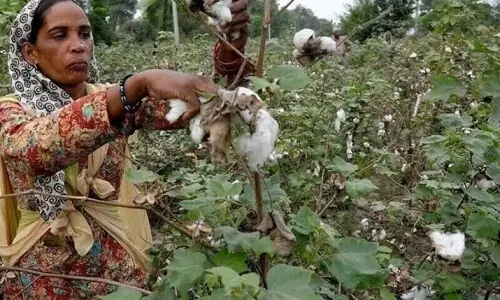
Over half of all victims of trafficking detected in South Asia are exploited for forced labour. This has consistently been the most detected form of exploitation in the region for years.
Almost all victims detected in the region were trafficked domestically with less than one per cent trafficked across borders.
As an origination point, countries in East Asia and the Pacific, Western and Southern Europe, and North America have reported an increasing number of South Asian victims since 2017.
In 2020, 5,523 individuals, men, and women were contacted by law enforcement authorities in South Asian countries about investigations of trafficking.In the same year, at least 3,787 people were prosecuted for trafficking in persons, and only 167 were convicted.
Published in Dawn, January 28th, 2023