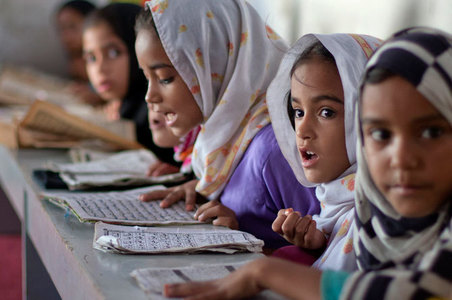
LAHORE: The Punjab School Education Department has directed all divisional, district and chief executive officers of the schools to extend teaching of the Holy Quran as a compulsory subject from primary to higher secondary.
The Directorate of Public Instructions (EE) Punjab Director Rana Abdul Qayyum Khan issued the notification.
The notification says teaching of the Holy Quran has already been introduced as compulsory subject in all public & private schools (up to primary level). Now the Punjab Curriculum and Textbook Board (PCTB) has also issued the scheme of studies regarding the teaching of the holy book.
It states now this subject is compulsory for all levels of classes i.e. Class-I to XII in primary, elementary, high and higher secondary level schools, under the 2018 Act Amended in 2021.
The notification said some necessary directions and guidelines regarding teaching of the Holy Quran had been circulated in the field from time to time to ensure implementation in true spirit.
It directed all heads of institutions, supervisory staff and district education authorities to “get the School Education Department policies implemented in letter and spirit and further to ensure that regular classes/period of the compulsory subject are observed as per timetable in all the schools (public & private) under their domain /jurisdiction.”
It further directed all the divisional directors and additional directors to monitor the teaching and learning process of the subject in the schools throughout the division and reports on a monthly basis should be submitted to the directorate on a regular basis till the 5th of every month.
It also directed the Punjab Examination Commission CEO to prepare a question bank for the compulsory subject in the sense that quality of teaching and learning could be determined..
Punjab Teachers Union leader Rana Liaqat told Dawn that earlier, the schools were teaching Holy Quran for 20 minutes and not as a subject.
He said the directors of district and division were directed to start teaching Holy Quran as a subject. “We have to give 8 lectures in school on a daily basis but after teaching Quran as a subject we would have to arrange nine lectures per day,” he said.
He said that the government had created new vacancies of Quran teacher for every school but they did not have any Quran teachers in almost 47,000 schools of the province.
He said Arabic and Islamiyat teachers were provided training and directed to hold Quran teaching in their respective schools.
He said that the government should appoint more than one Quran teacher in high and higher secondary schools of the province to teach Quran to students of grade 1 to 12.
BILL: On May 4, 2018, the Punjab Assembly passed a bill making the teaching of the Holy Quran compulsory in schools across the province.
Earlier, the National Assembly passed a bill making the teaching of the Holy Quran compulsory in educational institutions owned and controlled by the federal government.
Published in Dawn, january 1st, 2023