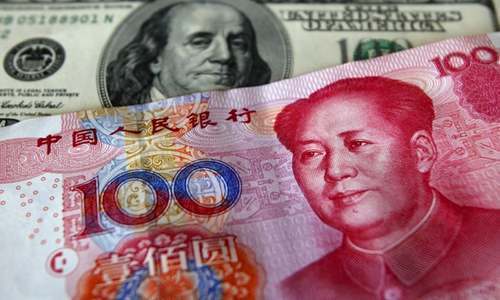
KARACHI: The central banks of Pakistan and China signed a memorandum of cooperation on yuan clearing in Pakistan, the Chinese central bank said in a statement on Wednesday, without giving more details.
The arrangement could pave the way for an alternative payment option for Pakistan, boosting yuan usage for cross-border transactions among Chinese and Pakistani enterprises and financial institutions.
The development is being seen in the financial sector as something that might also help Pakistan buy discounted Russian oil, as the Chinese currency was acceptable to Russia. Pakistan is currently making oil payments in US dollars.
In early October, a US State Department spokesperson told Dawn that Pakistan could be one of the beneficiaries of a US decision to “keep Russian oil available” in the market for lower and middle-income countries.
The spokesperson said that this relaxation should not be seen as a move towards easing the sanctions the US had imposed on Russia for invading Ukraine in February this year, but he was quick to point out that “other countries will have to make their own choices based on their own circumstances in terms of energy imports”.
Russia, hit by sanctions from the United States and its allies following its invasion of Ukraine, has been seeking to export its commodities in its own currency, the rouble.
Western sanctions have also prompted many oil importers to move away from Moscow, pushing spot prices for Russian crude to record discounts against other grades.
From the Russian side, the only ‘alternative’ currency that stood out in outgoing transactions is the yuan, as its share by the end of 2021 had risen to almost a third of all Russia’s payments to China. In contrast, 70 per cent of Russian payments to India were done in dollars.
India and Russia have agreed to trade in their local currencies, but the Russian importers are reluctant to accept the Indian rupee due to its low acceptance in the global market.
Similarly, Pakistan would not be able to trade in rupees with Russia, but the yuan it received from imports to China might help Pakistan buy Russian oil.
Besides, yuan clearing “will also help Pakistan to get better access to Chinese banks and it would be easy for Pakistan to make commercial borrowings from them”, a senior banker said.
According to the Indian government data, imports from Russia skyrocketed to $17.24 billion in April-August this fiscal year from about $3.2 billion a year ago due to higher oil purchases.
In 2021, 53.4pc of all payments from India to Russia were made in roubles, while 38.3pc were in dollars. India emerged as a leading foreign country to switch to the Russian currency.
Published in Dawn, November 3rd, 2022