Brazil votes in ‘tense’ Lula vs Bolsonaro presidential runoff


 1
1


BRASILIA: A polarised Brazilian electorate began casting votes on Sunday in a knife-edge presidential runoff that pits far-right incumbent President Jair Bolsonaro against leftist former leader Luiz Inacio Lula da Silva.
Bolsonaro has vowed to consolidate a sharp rightward turn in Brazilian politics after a presidency that witnessed one of the world’s deadliest Covid-19 epidemics and widespread deforestation in the Amazon basin.
Lula promises more social and environmental responsibility, evoking the rising prosperity of his 2003-2010 presidency, before corruption scandals tarnished his Workers Party.
Some 120 million voters are expected to punch their choices into electronic voting machines that Bolsonaro has criticised without proof as fraud-prone, raising concern he may not concede defeat, following the example of his ideological ally, former US President Donald Trump.
That has added to tensions in Brazil’s most polarising election since its return to democracy in 1985 after a military dictatorship that Lula, a former union leader, rallied against and Bolsonaro, a former army captain, invokes with nostalgia.
Brazil’s sharp partisan division has split its population in two.
With Bolsonaro stickers on her chest, Rio de Janeiro resident Ana Maria Vieira said she was certain to vote for the president and would never countenance picking Lula.
“I saw what Lula and his criminal gang did to this country,” she said, as she arrived to vote in Rio’s Copacabana neighbourhood, adding that she thought Bolsonaro’s handling of the economy had been “fantastic”. At the same polling station, Antonia Cordeiro, 49, said she had just voted for Lula.
She said Bolsonaro had only worried about the concerns of the rich, at least until the final days of the campaign when he rolled out poverty-busting measures to win votes.
“We can’t continue with Bolsonaro, she said. “He hasn’t worked.”
Race tightens
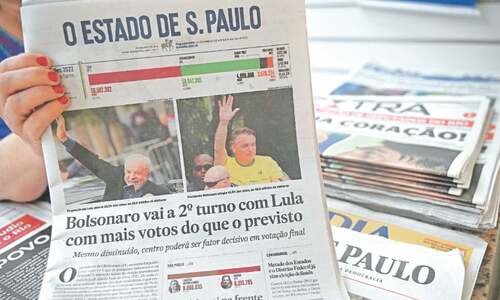
Several polls showed the race between them tightening in the final week, with Bolsonaro eroding a slight lead for Lula. Others show a small but steady advantage for Lula.
Bolsonaro outperformed opinion polls in the first round of voting on Oct. 2 among a field of 11 candidates. Pollsters said they recalibrated their methods based on that result, but most analysts still say Sunday’s runoff could go either way.
Bolsonaro voted early on Sunday at a military base in Rio.
“Our expectation is victory, for the good of Brazil,” he told journalists after voting.
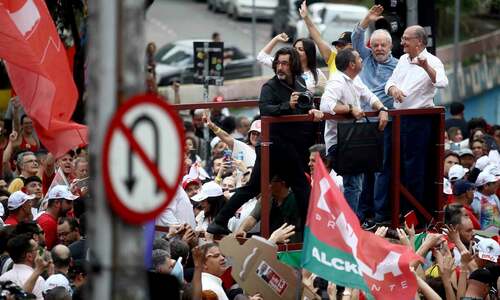
Lula voted at a school in Sao Bernardo do Campo, in Sao Paulo, where he arrived with his running mate Geraldo Alckmin and several other members of his team.
A victory for Lula would mark a stunning comeback for the leftist leader, who was jailed in 2018 for 19 months on bribery convictions that the Supreme Court overturned last year, clearing the way for him to seek a third presidential term.
Lula has vowed a return to state-driven economic growth and social policies that helped lift millions out of poverty during a commodity boom when he first governed Brazil. He also vows to combat destruction of the Amazon rainforest, now at a 15-year high, and make Brazil a leader in global climate talks.
A second term for Bolsonaro would keep Brazil on a path of free-market reforms and looser environmental protections, while cementing a coalition of right-wing parties and powerful farm interests, which bankrolled his campaign.
Post-election concerns
Brazil’s electoral authorities are preparing for a narrow result, which Bolsonaro may contest if he loses.
The president has spent more than a year questioning the reliability of Brazil’s electronic voting system. Although there has been no evidence of fraud since it was implemented in 1996, many of Bolsonaro’s supporters now doubt the credibility of the country’s elections.
A rising tide of political violence this year, punctuated in recent weeks by armed confrontations involving high-profile Bolsonaro allies, has added to fears that contested election result could trigger unrest.
The Superior Electoral Court (TSE), led by justices from the Supreme Court, has devised a security plan to protect its staff and buildings in the event of demonstrations like the January 2021 assault on the US Capitol.
Bolsonaro’s allies are organizing a “Victory Party” on Brasilia’s central esplanade on Sunday during the vote count.
The president has also asked supporters to stick around voting stations until they close at 5pm on Sunday, which critics say could intimidate voters and lead to clashes.
Lula, who was born into poverty and led union strikes against Brazil’s military government before founding the Workers Party in the 1980s, has called on voters to defend Brazil’s democracy from Bolsonaro’s “neofascism.”
Published in Dawn, October 31st, 2022