LAHORE: “The situation in India-held Jammu and Kashmir is not of human rights violations, rather it’s a human rights apocalypse,” says a freedom proponent.
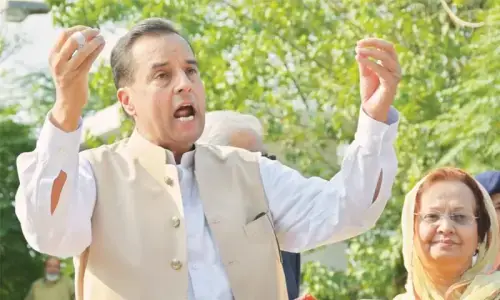
Muzzammil Ayyub Thakkur, president of the World Kashmir Freedom Movement, summed up the plight of Kashmiris at a session titled “Challenges to peaceful coexistence - Kashmir and religious intolerance in India/State of minorities in Kashmir” held on the last day of the Asma Jahangir Conference 2022 at a local hotel on Sunday.
British author and historian Victoria Schofield opened the session by reciting a verse from Faiz’s poem Chund Roz Aur Meri Jaan. She invited Christine Chung, human rights officer, OHCR, who dilated upon the UN’s two reports on Kashmir in 2018 and 2019. Ms Chung said the UN made recommendations to the governments of India and Pakistan and the world community, which were not honoured.
Mr Thakkur, a Kashmiri who was born in exile, said every single family [of Kashmir] had a story [of travails] to tell. He spoke of consequences of living in exile and said even the ‘privileged’ had to suffer.
Indian social and women rights activist Syeda Saiyidain Hameed, who was born in Kashmir, recollected the days she and Asma Jahangir visited the valley and Srinagar.
Ms Hameed spoke of Women’s Voice fact-finding report on the state of human rights in 2019. She concluded her talk with “My janambhoomi and karmbhoomi is Kashmir.”
Indian activist and director, South Asia Forum for Human Rights, Tapan K. Bose, who participated in the event virtually, talked of changed domicile law and Article 370 of the Constitution of India. The Article 370 inserted in 1949 gave special powers to the State of Jammu and Kashmir, lawfully authorising it to have its own constitution.
Former head, Amnesty International India, journalist and rights activist, Akar Patel, [another virtual participant], pointed out the abysmally thin representation of Muslims in cabinets in various states since 1947. He said many states banned inter-faith marriages. Mr Patel said that in 2017, India’s Supreme Court criminalised utterance of word ‘Talaq’ thrice in one go.
Mr Patel narrated an anecdote wherein a Muslim was booked for serving beef on the wedding of his daughter in Gujarat in 2019.
Published in Dawn, October 24th, 2022