1
1
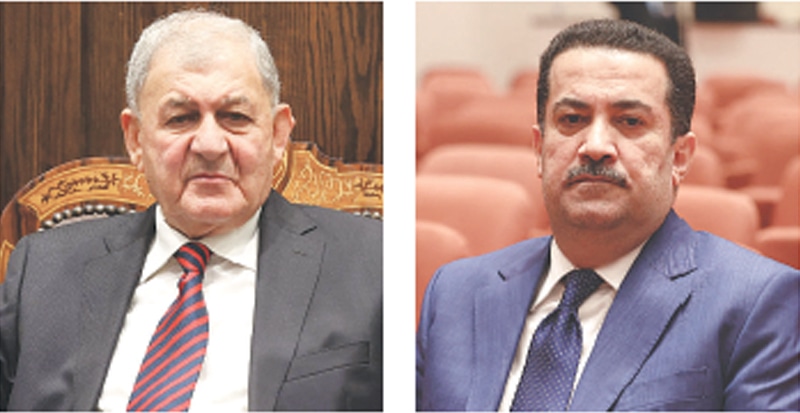
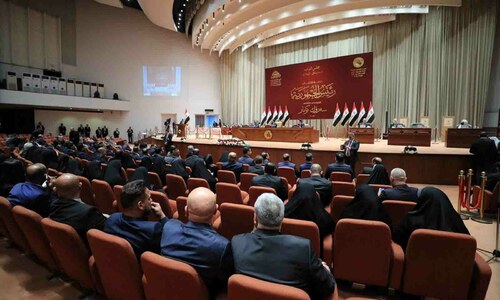
BAGHDAD: Despite a rocket attack on Baghdad’s Green Zone, Iraqi lawmakers on Thursday elected a new president who swiftly named a prime minister in hopes of ending a year of political gridlock and violence in the war-scarred nation.
Abdel Latif Rashid, a 78-year-old Iraqi Kurd, was elected as head of state, replacing Barham Saleh, by the assembly in the capital’s heavily fortified Green Zone government and diplomatic district. Rashid won more than 160 votes against 99 for the incumbent Saleh, an assembly official said.
The new president swiftly named Mohammed Shia al-Sudani as prime minister-designate, tasking him with reconciling feuding Shia factions and forming a government a whole year after Iraq last went to the polls.
The 52-year-old Sudani, who has the backing of influential pro-Iran factions, vowed to form a government “as quickly as possible” but faces the daunting task of winning over their rivals, the millions of diehard supporters of fiery cleric Moqtada Sadr.
When Sudani was first proposed in July, the move sparked mass protests by Sadr’s followers, who breached the Green Zone and stormed parliament. He now has 30 days to form a new government capable of commanding a majority in parliament.
Lawmakers had made three previous attempts to elect a new head of state, in February and March, but failed to even reach the required two-thirds threshold for a quorum. Under Iraq’s post-Saddam power-sharing system, meant to avoid more sectarian conflict, the president by convention is Kurdish, the prime minister a Shia Arab and the parliament speaker a Sunni Arab.
US ambassador Alina Romanowski condemned the attack “in the strongest terms” on Twitter and warned that “the people of Iraq must resolve their political differences & grievances solely thru peaceful means. “Attacks like these undermine democracy & trap Iraq in a perpetual cycle of violence.” The democratic institutions built in oil-rich Iraq since the 2003 US-led invasion that toppled dictator Saddam Hussein remain fragile, and neighbouring Iran wields major influence.
Published in Dawn, October 14th, 2022