ISLAMABAD: Supreme Court Justice Ijaz-ul-Ahsan wondered on Thursday whether “wiping out” of a conviction to an accused after entering into plea bargain, under the recent amendments in the National Accountability Ordinance (NAO), was akin to the presidential pardon, even though the former was awarded by a court of law for corrupt practices.
“It’s something even the president, by exercising his constitutional authority to pardon, cannot do,” observed Justice Ahsan.
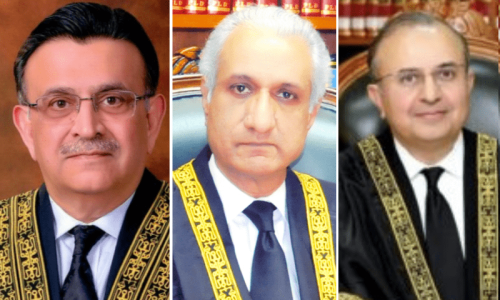
Headed by Chief Justice of Pakistan (CJP) Umar Ata Bandial, Justice Ahsan was one of the members of a three-judge Supreme Court bench hearing a challenge by PTI chairman Imran Khan to the amendments made in the NAB law in August.
During proceedings on Thursday, Justice Ahsan said a question comes to mind: whether a conviction under the accountability law can be erased through subsequent legislation, especially if a conviction awarded by a court stays until the president pardons someone.
Mumtaz Yousuf, an additional prosecutor general of the National Accountability Bureau, told the Supreme Court that 219 references had been withdrawn so far from different courts and referred back to NAB after recent amendments in the law.
He explained that NAB had constituted a committee to determine which case would still fall within its jurisdiction and which should be referred to relevant forums in view of the amendments.
From 2000 to 2022, NAB recovered an amount of Rs91.547 billion — Rs65bn through plea bargain and the rest under the voluntary return plan, the official added.
Justice Syed Mansoor Ali Shah asked senior counsel Khawaja Haris Ahmed, who represents the petitioner, if amendments were intended to make the accountability law favourable to offenders, would it not amount to violation of fundamental rights.
Justice Shah observed a conviction that followed a plea bargain was not a conviction in the “real sense of the word” since convictions are awarded by a court of law after a trial of an accused. Khawaja Haris said a plea bargain agreement was considered successful if an accused confesses to a crime and then agrees to return the money in return for “a lighter punishment”.
Justice Shah reminded him that not only a sentence but also a conviction is nullified if a convict in a murder case enters into a settlement with the victim’s family. In such cases, the accused can even be re-employed, Justice Shah said.
Chief Justice Umar Ata Bandial, addressing Khawaja Haris, said he must appreciate that drafting of the amendments to NAB law was very good, for which the law minister deserves praise.
Justice Ahsan agreed with the observation.
Published in Dawn, October 7th, 2022