Commodity crunch



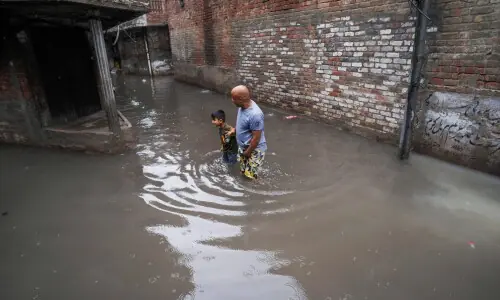
PAKISTAN is in the grip of serious food security concerns, especially regarding the availability and high prices of edible commodities. The devastating floods, that have washed away farm produce, are a major reason for the commodity crunch. Earlier, the ongoing Russia-Ukraine war had also created shortages of commodities, especially of wheat. The prices of staples, including vegetables, have risen sharply. The tomato and onion crop, in particular, has been severely affected.
Previously, shortages, particularly of vegetables, were met by ready imports from neighbours, especially India via the Wagah border, because of economical rates and low transportation costs. This time, vegetables from India could not be imported as direct trade with India has been disrupted since 2019 when New Delhi illegally annexed Jammu and Kashmir. The alternative is to import Indian commodities via Dubai, which would be costlier. As it is, much of the Pakistan-India trade is now through the UAE, to the detriment of Pakistani and Indian traders and consumers. Imports have also been allowed from Iran and Afghanistan. Another proposal is to temporarily abolish duties and taxes on the import to stabilise commodity prices.
The floods show clearly that food security can’t be taken for granted, and we need short-, medium- and long-term plans. The immediate concerns pertain to the scarcity of wheat and vegetables and the exorbitant prices of food items. Pakistan has already initiated steps to import wheat. As for vegetables, in the larger public interest, the government should consider importing these from within the region, rather than far-flung countries, as a more efficient and cost-effective alternative.
For food security in the medium term, Pakistan should factor in the dictates of geo-economics and geography. Trading arrangements with all its four neighbours should be encouraged as long as better, affordable products are available and the neighbours also open their markets for Pakistani products. Politics aside, the socioeconomic well-being of our people should remain the top priority. An economically stronger Pakistan can better protect its geopolitical interests. This was prudently stipulated in the National Security Policy. As it is, regional trade builds peace constituencies, providing political and economic stability. The EU and Asean experiences are a case in point. South Asia has much to learn from them.
Trade with neighbours should be encouraged.
For the long term, Pakistani political and thought leaders need to seriously reflect on how the needs of a growing population will be met in the years ahead. With over 220 million inhabitants, Pakistan is now the world’s fifth most populous country. Estimates indicate that our population will rise to 260m by 2030 and 380m by 2050, placing enormous pressure on national systems responsible for providing food, water, education, health, housing, etc. Unless economic growth keeps pace with an ever-growing population, Pakistan could face huge food shortages and energy crunches, apart from high unemployment.
For us to become a food-secure country, we must find ways to enhance agricultural productivity and ensure self-sufficiency in edible items. If we cannot produce enough from our own lands, edible items should be sourced from the region or wherever we get better prices. We must also not lose fertile agricultural land to urban dwellings. Even the designated agro-farms in city suburbs, which have become palatial farmhouses, should be restored as nurseries for growing vegetables.
Most notably, climate change has emerged as an existential threat. Pakistan is among the countries most vulnerable to it. Flash floods, torrential rains, changing patterns of monsoons, cloudbursts, melting glaciers, heatwaves, and extreme weather events are only some of the manifestations of climate change. Food will be an immediate casualty of any climate-induced event in Pakistan. Forecasts of wheat and rice production for the next season have already been lowered owing to the floods. That means larger import bills for meeting the people’s food requirements. Whether it is water scarcity or abundance, we need to learn to manage our waters.
The larger remedy to the multipronged challenges confronting Pakistan is to let geo-economics guide our policy decisions. A country dependent on foreign aid is not in a position to defend its sovereignty or play geopolitics to its advantage. Conversely, a country with a flourishing economy would be far more secure internally and respected externally. Countries like Singapore, the UAE and Vietnam have shown how a strong economy wins respect in the comity of nations. The opportunities provided by regional trade to avert commodity crunches must not be squandered. Can we prioritise geo-economics over geopolitics? Yes, we can, and we must.
The writer, a former foreign secretary, is director general of the Institute of Strategic Studies Islamabad, and author of Diplomatic Footprints.
Published in Dawn, September 23rd, 2022