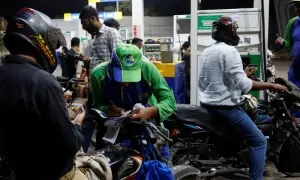
ISLAMABAD: While 78pc of households have no access to natural gas in Pakistan, exploration and production have declined in the country.
“OGDCL predicts that Pakistan’s indigenous oil reserves will be exhausted by 2025, the circular debt in the gas sector has crossed Rs1.5 trillion, politically influenced allocations and monopolistic business operations are all bottlenecks.”
These observations were made by Pakistan Institute of Development Economics (PIDE) in its latest research brief on “Gas crises in Pakistan”.
It stated that gas is the third largest energy source consumed around the world. However, Pakistan has less than a one per cent share in world gas consumption. It meets its energy demand through imported and indigenous resources in the ratio of 44:56. Natural gas and imported LNG contribute more than 40pc to the country’s current energy mix, including gas resources used in electricity generation. In recent years, the demand for gas has increased rapidly in Pakistan. However, gas exploration and production have declined, and the LNG operational and regulatory framework is weak, leading to a nationwide shortage and increased supply costs.
Says govt’s poor policy formulation creating inefficiencies in supply chain
According to a press release issued by PIDE, 15 gas explorations and production companies worked in 55 fields spread throughout the country. The gas distribution and transmission are mainly owned and operated by two state-owned companies - Sui Northern Gas Pipelines (SNGPL) and Sui Southern Gas Company (SSGCL). The gas exploration/production industry and gas distribution/transmission industry lack competition in Pakistan.
“OGDCL predicts that Pakistan’s indigenous oil reserves will be exhausted by 2025. However, current reserves will last a maximum of 15 years if demand is capped at present day gas levels by 2030.”
PIDE research showed that 78pc of households had no access to natural gas in Pakistan. Natural gas consumption in the domestic sector has grown by about 11pc over the years. Supplying gas to households requires significant investments. The cost of gas supply to households is much higher than the cost of supply to the industry or power sector. Gas allocation policy has remained based on political priorities rather than on the objective of maximising value addition. Low gas prices and inefficient gas allocations have encouraged higher demands.
With 30.6 billion cubic metres of natural gas, Pakistan shares 0.8pc of global production. There is a sharp increase in gas demand in Pakistan, but due to the inefficient distribution the country has been facing a colossal gas shortfall.
The brief described that large areas in the country remain unexplored due to security concerns and law and order situation. For instance, Balochistan’s Pishin basin is considered a valuable block. However, there has been no exploration activity in this basin because of the law and order issue.
According to the PIDE, all activities in the gas sector in Pakistan, directly or indirectly, are under the government control. An independent regulator was established in 2002 to regulate mid and downstream activities. Still it remains hostage to government decisions because of the extensive state presence in all activities in the supply chain. Ogra law allows too much mandatory government involvement in the current oil and gas regulatory system. This has made the regulator powerless. Government interference in service providers’ affairs has led to cross-subsidy and an overall deficit in the gas sector. The circular debt in the gas sector has crossed Rs1.5 trillion, contributed by both the SNGPL and SSGPL. Government irregularities in regulatory frameworks and poor policy formulation are hindering sectoral growth and creating inefficiencies in the supply chain.
The brief suggested prioritizing exploration activities to rely on LNG imports, correct well head prices, and minimise government interference. A progressive and market-based exploration policy is needed. Pakistan should deregulate the natural gas sector and liberalise the pricing structure. Market-based pricing systems will also curtail the misuse of gas. For LNG imports, incentivise third-party access increased involvement of the private sector in the LNG supply chain happening in mature LNG markets like Japan, South Korea and even India.
Published in Dawn, September 12th, 2022