Twin cities face dengue threat

ISLAMABAD/RAWALPINDI: The district health officer of Islamabad warned of a rise in dengue cases in the light of excessive rainfall during the current monsoon, as Rawalpindi continued to report dozens of dengue patients with 39 more patients admitted to three government hospitals on Sunday.
Referring to stagnant water accumulated in ponds and low-lying areas after the rainfall, Islamabad District Health Officer Dr Zaeem Zia said the stagnant rainwater was an ideal breeding ground for the growth of the dengue larvae and urged timely measures to contain the threat.
Though Islamabad reported only one case in the past 24 hours from its urban areas and a total of 124 infections during this year, Dr Zaeem Zia warned that the number of dengue cases could rise in the capital if adequate measures were further delayed.
Pindi reports 39 more cases; Islamabad health officer warns of spike in cases due to unprecedented rainfall
“Almost all parts of the country have faced floods and more than usual rains…the accumulated rainwater in ponds and low-lying areas will become a breeding ground for mosquitoes,” he cautioned.
He said the Islamabad administration had adopted a proactive approach and teams were being sent to different areas of the capital to drain out the stagnant water and raise awareness among the public against the viral disease.
39 more patients in Pindi
Another 39 patients arrived at hospitals in Rawalpindi, taking the total tally of patients to 567 during the current season.
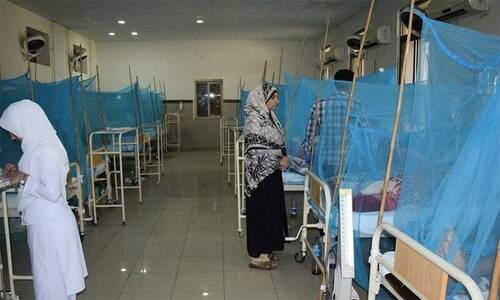
Out of 110 patients who were admitted to three government-run hospitals during the past 24 hours, 34 patients were being treated at Holy Family Hospital (HFH), 33 patients in Benazir Bhutto Hospital and 43 patients were admitted to the District Headquarters (DHQ) Hospital in Raja Bazaar. Out of the total number, 19 patients arrived from Islamabad, 88 from Rawalpindi while one patient each came from Attock, Haripur and Jhelum.
“More than 100 suspected patients have been admitted to the hospital’s dengue ward,” District Health Authority Chief Executive Officer Dr Anser Ishaq told Dawn.
He said the dengue serology report of the suspected patients would be received on Monday which would confirm if the said patients were infected with dengue.
“The number of patients increased with each passing day. We are adopting precautionary measures to avoid further spread of the virus in other parts of the garrison city,” he said, adding that due to an increase in the number of patients, there was a need to speed up the anti-dengue drive to avert a 2019-like situation when more than 4,200 dengue patients were reported.
Published in Dawn, September 5th, 2022