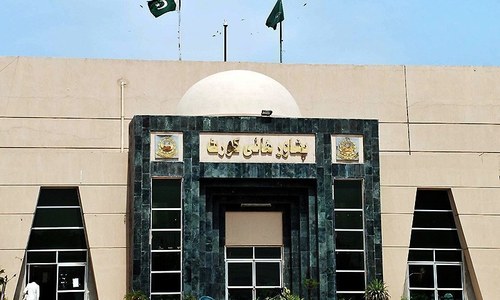
PESHAWAR: The Peshawar High Court has dismissed a petition against assigning additional charge of the chief executive officer of newly-established Timergara Medical College (TMC), Lower Dir, and its teaching hospital to an official of the health department by the provincial government.
A bench of Justice Mohammad Naeem Anwar and Justice Mohammad Ijaz Khan also turned down the request made in the petition to issue directives to the government to appoint principal/dean/chief executive for TMC and its teaching hospital under the relevant law.
The petition was jointly filed by two citizens of Lower Dir, Azad Bakht and Bakhtawar Said, seeking directives of the court for the government to withdraw the relevant notifications issued in favour of Dr Shaukat Ali, who is regional director health services, Malakand, and also assigned the additional charge of CEO TMC and its attached teaching hospital.
They also requested the court to declare as illegal the recruitment process started by the respondent (Dr Shaukat) for the college.
Rules qualification will be considered when faculty members are appointed for Timergara Medical College
The petitioners’ counsel contended that the inauguration of TMC was held on July 4, 2015, and the District Headquarters Hospital, Timergara, was declared as its teaching hospital on May 18, 2020.
He argued that Dr Shaukat, who was earlier serving as medical superintendent of the DHQ Hospital, was posted as regional director health services, Malakand, and was also assigned the duty as project director of TMC through a notification on Sept 22, 2021. He stated that the said respondent was then assigned an additional charge of the post of CEO of TMC and DHQ Hospital, Timergara, on Jan 17, 2022.
He stated that some categories of posts out of the 436 posts, which were created and sanctioned by the provincial government, were advertised and for the screening test the respondent (Dr Shaukat) had hired the services of a testing agency named Hiring Testing Service (HTS), which was against the policy of the provincial government of conducting screening tests through the Education Testing and Evaluation Agency (Etea).
He argued that the respondent could not be appointed CEO of the medical college as under Regulation No 22 of the Pakistan Medical and Dental Council such post could be occupied by the principal having level-III qualification in medical sciences, which the respondent lacked.
The bench observed that the respondent (Dr Shaukat) was declared to act as project director for the ADP Scheme named “Establishment of Timergara Medical College, Dir Lower” through a notification on July 28, 2017, and he was assigned different tasks through TORs (terms of reference).
The bench ruled that the record showed that many of the tasks mentioned in the TORs were yet to be completed, including the appointment of employees for the college, and as such the project was yet to be finalised.
About the qualification required for principal of a medical college, the bench ruled that plain reading of the regulation would show that this rule would only be applicable when the faculty members, including professors, were appointed and then out of them a professor of level-III qualification should be appointed as principal by the competent authority.
The court observed that establishment of TMC was going through transition period and at this stage such objections of the petitioners could not be legally sustainable.
About the petitioners’ request to direct the provincial government to appoint principal/dean /chief executive for TMC and DHQ teaching hospital, the bench ruled that such stage of appointment had yet to reach as the principal had to be appointed by the competent authority at the relevant time, therefore, the prayer of the petitioners was premature.
The bench ruled that the petitioners’ prayer that process of appointments be carried out through testing agency named Etea instead of HTA, would amount to the court’s interference in affairs of the provincial government when it was an entirely administrative decision.
Published in Dawn, August 8th, 2022