Sri Lankan troops demolish protest camp



COLOMBO: Sri Lankan security forces demolished the main anti-government protest camp in the capital on Friday, evicting activists in a pre-dawn assault that raised international concern for dissent under the crisis-wracked country’s new pro-Western president.
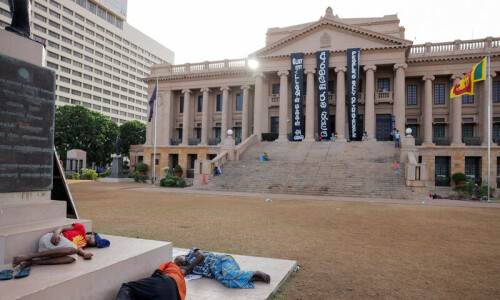
Troops and police Special Task Force commandos wielding batons and armed with automatic assault rifles charged on people blockading the sea-front Presidential Secretariat in Colombo.
Hundreds of soldiers removed the demonstrators’ barricades and tents outside the colonial-era building, while the last remaining protesters on the premises — some were still on the steps — were baton charged away.
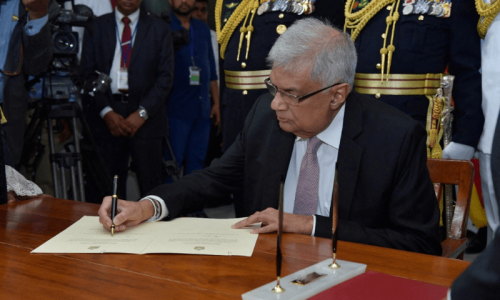
The operation came hours before new president Ranil Wickremesinghe appointed an old friend as prime minister and the ousted head of state’s personal lawyer as foreign minister.
US ambassador in Colombo ‘deeply concerned’ about military action
Wickremesinghe was elected president by lawmakers on Wednesday to replace Gotabaya Rajapaksa, who fled to Singapore and resigned after demonstrators chased him from his palace.
The remaining protesters — far fewer than the thousands who overran several government buildings earlier this month — have been demanding Wickremesinghe also quit. They accuse him of protecting the Rajapaksa clan who have dominated politics for much of the last two decades.
By sunrise, police commandos and soldiers barricaded the complex and the main roads leading to the area were cordoned off. Hundreds of activists demonstrated at a nearby designated protest site against the military action, demanding Wickremesinghe resign and dissolve parliament and allow fresh elections.
“Don’t attack peaceful protesters, instead listen to us,” said student Dimmithu, 26.
The activists insisted they would continue their struggle, and Basantha Samarasinghe, 45, a businessman and trade union leader, said: “The peoples’ wish is system change, and parliament should be dissolved. It has no public mandate.”
Police said in a statement that security forces acted to clear protesters who were “illegally occupying” the presidential compound, with nine people arrested, two of whom were injured.
The US ambassador in Colombo, Julie Chung, said she was “deeply concerned” about the military action. “We urge restraint by authorities and immediate access to medical attention for those injured,” she said on Twitter.
The European Union said freedom of expression was essential for Sri Lanka to transition from its chaos.
“Hard to see how restricting it severely can help in finding solutions to the current political and economic crises,” the EU delegation in Colombo said.
A foreign exchange crisis triggered by the coronavirus pandemic and exacerbated by mismanagement has left Sri Lanka suffering lengthy power blackouts and record-high inflation.
The country’s 22 million people have also endured months of food, fuel and medicine shortages.
On Friday, Wickremesinghe swore in his political rival Dinesh Gunawardena as the country’s new prime minister.
The two men have been schoolmates and friends since the age of three but lead political parties that are opposed ideologically.
Wickremesinghe is a free-market champion and a pro-West politician while Gunawardena is a staunch Sinhala nationalist who believes in socialism and wants greater state control over the economy.
“We have differences, but we have enough friendship to unite to deal with the main problem of the country, that is the economy,” Gunawardena told reporters.
Wickremesinghe also swore in a new cabinet, largely re-instating his predecessor’s ministers but retaining the finance portfolio for himself to continue bailout talks with the IMF.
He also replaced the foreign minister with Gotabaya Rajapaksa’s personal lawyer Ali Sabry.
Officials said it was an “interim cabinet” that could be replaced “within weeks”.
Published in Dawn, July 23rd, 2022