1
1


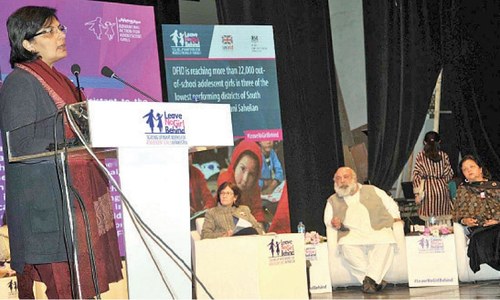
ISLAMABAD: The United Kingdom has announced a bilateral programme worth up to 130 million pounds to support girls’ education in Pakistan that will impact nearly 17 million children.
The programme, titled “Girls and Out of School: Action for Learning (GOAL)”, will support the governments of Punjab and Khyber Pakhtunkhwa to improve outcomes for girls and the most marginalised.
Launched in May this year, the Prime Minister’s Girls’ Education Action Plan sets out practical steps to deliver the UK’s global objectives on girls’ education.
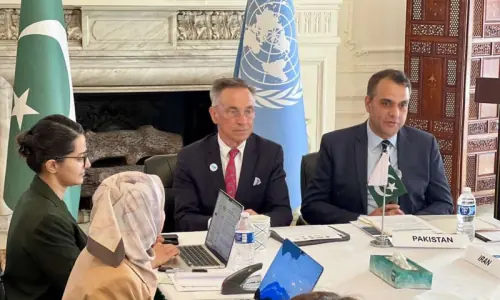
Commenting on the UK’s financial assistance for the girls’ education programme in Pakistan, High Commissioner Dr Christian Turner said that no nation can reach its full potential without 50 per cent of its population. Getting girls into school is a key driver of growth, and “we want to give girls ‘awaaz’ and ‘marzi’, voice and choice and unleash the potential of the next generation”.
The UK announced the programme on Saturday.
GOAL focuses on two main priorities, and in Punjab and KP’s least developed districts, it will directly support around 250,000 marginalised children to enrol and stay in school. It will also support an additional 150,000 girls to read by age 10.
GOAL will improve learning outcomes for at least 16.9 million children (7.8 million girls) by strengthening the provincial education systems to improve the quality and equity of education, particularly the quality of teaching, and becoming more resilient post-Covid. The programme will directly support children to access education and learning in several Commonwealth countries.
GOAL will introduce changes to make education more inclusive; ensuring children are taught at their correct learning level, and influencing others to adopt better education practices.
Statistics show that there are 132 million girls out of school in the world — about 9.2 per cent (12.2 million) are in Pakistan. Girls’ education remains a significant challenge with lower enrolment rates and higher drop-out rates for girls, particularly at the transition from primary to secondary school.
The poorest rural girls are most affected: 54pc of the poorest 25pc of girls are out of school and these girls are only achieving one third of the learning of the wealthiest 25pc of girls and boys. In Punjab, the average literacy rate for women is 54pc (44pc in rural areas) compared to 72pc for men. A recent study shows that 2.2 million adolescent girls aged 15–19 years in Punjab are neither at school, nor employed or married.
Published in Dawn, June 27th, 2022