0
0

KARACHI: The second and final day of the conference on ‘Extreme Reporting: Conflict and Peace in the Digital Age’ organised by the Centre for Excellence in Journalism in collaboration with the US Consulate Karachi at the IBA City Campus here on Sunday focussed on many issues that journalists face while working on unearthing the real facts to provide authentic news.
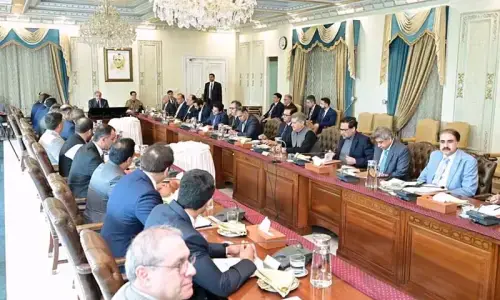
The chief guest on the day was Federal Minister of Power Khurram Dastagir Khan, who in his keynote address spoke about twisting of facts and fake news that even the mainstream media has been a victim of in present times of social media when rumours are rife and the truth is bitter.
“Social media has erased the line between truth and lies, and this in my view is extreme reporting. Where facts are manufactured and reality altered,” said the Federal Minister.
“Extreme reporting is an endeavour that requires bravery, strength and courage. If you look at Pakistan’s history there have been courageous men and women who have tried to express the truth and they have suffered for it. Journalists have been shot in broad daylight, kidnapped and what not? But the media has failed to save the public from lies. It has put us in a difficult position. It might be an exaggeration to say so but this erasure of the line between truth and lies is endangering democracy worldwide,” he said.
CEJ conference on extreme reporting concludes
“In this country, democracy is a one leaf plant that is crushed every so often and the media’s challenges are immense because there are certain truths that cannot be said in this country and that is a fact. Just look at Balochistan. Why are we not allowed to talk about its truth?” He asked.
Session on reporting from conflict zone
Earlier, the day’s first session brought up a complex and engaging panel discussion moderated by senior journalist Aamer Ahmed Khan about ‘Reporting from the conflict zone.’
WIONews bureau chief Anas Mallick, who has reported from Afghanistan and Ukraine, pointed out no matter how much you prepare “a journalist is never prepared enough in a conflict zone”. He also spoke about the temptation to do a story while ignoring the risks and then getting scolded for it even after he got the story.
Sophia Saifi of CNN said that she has also been responsible for production and the teams that go out to cover from conflict zones like she was for Afghanistan. “Your safety is important. It is for your safety that every couple of years, every reporter has to go for training,” she said.
She also spoke about the importance of the desk. “The desk is not taken seriously but they are doing a lot of work in conflict zones from the office,” she said while also bringing up the social media where couch potatoes watching news at home post news and become the authority without doing the real journalists’ work.
The BBC’s bilingual correspondent Sahar Baloch said that when reporting from a conflict zone, every situation is unique. She also said that writing news for the print media is still easier than talking on camera where you are setting a tone. “And then you get to face another war on social media. But you need to detach yourself from all this when reporting because you can’t change your reportage based on that,” she said.
She said that in a conflict zone you don’t take permission to go here or there because the permission won’t be given and you would be made to wait forever but she has had to often stop herself from proceeding into a danger zone because she also had to think about her team.
TNN’s Khalida Naz and journalist trainer Raza Hamdani also spoke about how to equip reporters through training.
‘Conflict is everywhere’
The second session of the day ‘Beyond conflict’ was moderated by media personality and lawyer Ayesha Tammy Haq. She was joined on stage by journalist and researcher Iftikhar Firdous, author and communication specialist Shahzad Sharjeel, journalist and writer Umber Khairi and journalist Zia Ur Rehman on the panel.
The panel discussed reporting in a post-conflict world and the need for media houses to invest in their reporters.
Talking about how the panel and participants were born in times of conflict and are products of conflict, Ms Khairi said that conflict is everywhere, the entire country is in conflict. “I think it is important that when you look at conflict, you need to have some form of a reconciliation process as well,” she said.
Mr Rehman said he only remembers conflict. “I was born in Karachi, my entire upbringing, my school and university, everything was and still is in conflict. I don’t think conflict has ended, I think it has transformed and has a new face,” he said.
“If you look at Karachi, the conflict might look like it’s gone away but it has just been pushed into the background. The political, ethnic and sectarian conflict still exists but is not mainstream right now. We haven’t tried to understand or investigate why,” he added.
The last session of the day, ‘Is the future now?’ was moderated by Dawn.com editor and chief digital strategist Jahanzaib Haque. He was joined on stage by policy analyst and editor of The Friday Times and Naya Daur Raza Rumi, editor of Balochistan Voices Adnan Amir, TV producer and co-founder of The Current Mehmal Sarfaraz and the founder of The Centrum Media Talha Ahad.
Mr Rumi was of the opinion that digital media is not the future, it is the present. “Legacy media is out. In less than a decade or so you will see less public trust in legacy media and their business sense as well. On the other hand, social media has its own issues and digital media has its own issues,” he said.
Mr Amir said that when he started his career in journalism in Quetta, there was no space for him to contribute and mainstream media was not interested in covering Balochistan much. “So me and a few other journalists got together and started our own platform Balochistan Voices to get the news out. It is in English because we wanted our news to be accessible to a wider audience,” he said.
Meanwhile, the CEJ also announced the Peace Journalism Program Award and winners are Mehreen Burney from Lok Sujag, Tayyaba Nisar Khan from PTV World, Afifa Nasar Ullah from Deutsche Welle, Kaleemullah from Lok Sujag, Faiza Gillani from Country News/Hum News and Asmat Ali Akhun from Pakhtunkhwa Radio Swat Center.
Published in Dawn, June 27th, 2022