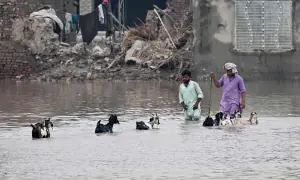
LAHORE: Dera Ghazi Khan and Rajanpur districts in south Punjab are facing acute water shortage as people from rain-fed and mountainous areas are moving along with their cattle towards urban centres in search of water to quench their and their animals’ thirst.
A Punjab irrigation official says water shortage in the region has increased to 82 per cent as the canal system there has been closed since February 22.
“The situation is precarious as water is available neither in the reservoirs nor in rivers. By this time the dams would have been half filled as per routine in the previous years, but both Tarbela and Mangla lakes are presently close to their dead levels,” he says.
The Indus River System Authority data shows total water inflow into the national system was 148,791 cusecs on Monday (May 9) with outflow 143,334 cusecs. Of this, Punjab was apportioned 77,700 cusecs, Sindh 63,000 cusecs, Khyber Pakhtunkhwa 3,000 cusecs and Balochistan 6,000 cusecs.
The irrigation official says 1,600 cusecs water has been released into the DG Canal against its capacity of 8,500 cusecs. This (1,600 cusecs) is being diverted to Dajal Canal, a branch of DG Canal, which feeds the areas that have brackish subsoil water, he adds, requesting not to be named for not being authorised to talk to the media.
The water scarcity is leading to disputes among farmers on distribution of whatever quantity of water is available. Former Punjab irrigation minister Mohsin Leghari, who belongs to Rajanpur district, says people are worried about the fate of their crops and livestock.
Many of them are ready to go for a protest against irrigation authorities on the Taunsa Barrage (the DG Canal emanates from) but some saner souls are advising them against the act because water is not there even in dams and rivers due to lack of rains and a slow pace of melting of snow in the rivers’ catchment areas, he says.
Mr Leghari says keeping in view the poor scenario of the availability of water throughout the season, he is urging growers of his area not to sow water-guzzling crops like rice, which has gained currency among the local farming community after successive failure of the cotton crop during the last five years or so.
Assistant Director Agriculture (extension) Dr Shoaib Ahmed says that over 80 per cent of cotton sowing target in the Rajanpur district has been achieved but the crop is under stress due to shortage of water. He says the growers may have to sow the crop afresh if the canal closure extends further.
Published in Dawn, May 10th, 2022