Tensions rise as West puts its weight decisively behind Ukraine


PARIS: Less cautious about its military support and more explicit in its war aims, the West shifted gears in its support for Ukraine this week despite the risk of a direct conflict with Russia.
“We want to see Russia weakened to the degree that it can’t do the kinds of things that it has done in invading Ukraine,” US Defence Secretary Lloyd Austin said on Monday.
The remark underlined Washington’s widening objectives in the conflict beyond simply enabling Ukraine to defend its territory from Russian attack.
On Tuesday, the United States convened talks on increasing support for Kyiv with around 40 countries — including all NATO members — at the Rammstein military base used by US forces in Germany.
On Wednesday, UK Foreign Secretary Liz Truss toughened British rhetoric as she called on the West to “ramp up” military production including tanks and planes to help Ukraine.
US says it’s ‘not attacking Russia’; Moscow shifting focus to attacks on infrastructure
She also said that Russia must be pushed out of “the whole of Ukraine”, implying that Britain backed Ukraine re-taking the province of Crimea which was annexed by Moscow in 2014.
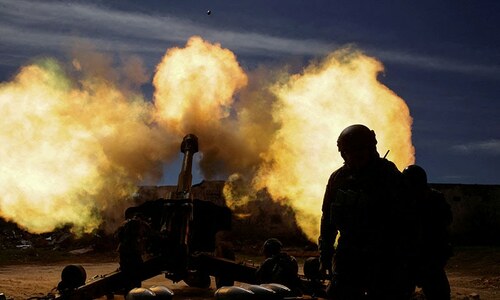
Having been reluctant to deliver heavy weapons to Ukraine in the early stages of the conflict, Britain, France, the United States and even Germany are now delivering increasingly sophisticated firepower.
US President Joe Biden announced a huge $33 billion package on Thursday for arming and supporting Ukraine, with the equivalent of 10 anti-tank weapons being supplied for every Russian tank.
‘Second phase’
“We’ve moved into a second phase of the war,” said Florent Parmentier, an expert on international relations at Sciences-Po university in Paris.
“There was a first stage where we simply wondered about the Ukrainians’ capacity to resist Russia.... (now) there’s more and more talk of encouraging Ukraine on the road to victory,” he added.
Marie Dumoulin, an expert at the European Council for Foreign Relations, believes “the West has come to terms with the idea that the war is going to last.” Jean-Sylvestre Mongrenier, from the Franco-Belgian think-tank Thomas More, says the new stance is a result of shifting understanding of Russian President Vladimir Putin’s objectives.
The West “appears to have understood that the future of the continent will play out in the Donbas” region of eastern Ukraine, he said, with Russia hoping to regain influence lost after the break-up of the Soviet Union.
The danger is that the more the West steps up its backing, the closer it becomes to being considered as a “co-belligerent” in the conflict, rather than a simple ally of Ukraine.
Russia “considers that as soon as you start delivering heavier and heavier arms, the difference between being a belligerent and not intervening becomes smaller and smaller,” said Parmentier.
Biden stressed on Thursday that “we’re not attacking Russia. We are helping Ukraine defend itself against Russian aggression.”
‘Unprecedented escalation’
With Western support increasing, Russia has stepped up its strikes on Ukrainian infrastructure needed for arms supplies such as train lines and bridges.
“If Russia considers that NATO is a co-belligerent, or one country is going too far in supplying arms, it wouldn’t be surprising to see strikes closer and closer to the border (with NATO countries) to send a message,” Parmentier added.
Russian Foreign Minister Sergei Lavrov warned on Monday that there was a “real” danger of a third world war.
On Wednesday, Putin warned that if any other country intervenes in Moscow’s military operation in Ukraine, Russia will launch a “lightening-fast” military response.
Published in Dawn, April 30th, 2022