HAVE you ever seen a yellow and white Pakistani flag? How about a grey giraffe? While it’s obvious that they don’t exist in real life, you will find them in pirated science and social studies textbooks across Pakistan.
These two examples are errors caused by pirates illegally photocopying or making low-quality, one-colour copies of copyrighted colour textbooks. But there are more concerning issues to note as Pakistan marks World Intellectual Property Day on April 26.
Unlike publishers who have reputations to maintain, pirates have no incentive to ensure the quality of the content they are counterfeiting. So, there is a mathematics textbook for six-year-olds in our country that tells children that 20 + 20 = 4. Established printing houses conduct numerous rounds of proofreading and fact-checking to ensure that such mistakes, where a letter or number is omitted, don’t happen. Just think of how many minds can be misled by that single error.
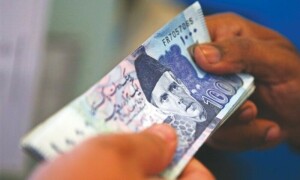
These stories point to a very serious reality. Every year, Pakistan suffers Rs240 billion in lost tax revenue and Rs757bn in lost book sales due to Intellectual Property (IP) Rights violations, according to a recent study by the Overseas Chamber of Commerce and Industry.
Piracy discourages research and innovation.
Intellectual property refers to creations of the mind that entitle the creator to protections such as copyright and trademarks, and crucially, royalties from the use or sale of their content. Royalties resulting from IP enabled J.K. Rowling, who was a struggling single mother on welfare support, to entertain millions of people around the world through films, theme parks and merchandise based on the copyrighted content of her Harry Potter books.
Any unauthorised use of IP is considered piracy and every sale of a pirated book in Pakistan robs an author of the rewards of their creativity and innovation. In fact, weak IP protections in Pakistan have meant that famous writers and authors such as Mushtaq Ahmed Yousufi and Fahmida Riaz have had to do jobs unrelated to their craft to make ends meet. Imagine what they could have produced in the time they spent earning a living?
In the long term, piracy discourages research and innovation due to the ease with which creative works, that take years of effort, can be pirated within days. This hinders the output of our universities as well as the creation of new knowledge that would have added value to our society and economy.
Young people are discouraged from being authors because of the poor financial incentives and this means that our young generation will lack access to local, original content on local problems. Sure, we can continue to import outdated editions of textbooks from abroad to educate our children, but by doing so aren’t we depriving them of the joy of learning about something that they can relate to?
So, what’s the solution? Even though Pakistan has an IPR law, the Intellectual Property Organisation Act of 2012, many cases have been lying in the courts for decades. Worse still, theft of copyrighted content and its resale is seen as a social good by the masses, who have grown used to downloading films and songs online, forwarding books via WhatsApp and watching videos on YouTube where a person holds a book to a phone camera and films every page.
Besides stricter legislation and stronger implementation of laws, artists and authors around the country need to come together to launch awareness campaigns highlighting the numerous harmful effects of piracy. Poor enforcement of IP rights means that most poets and authors have no sustainable source of income after they retire, or after they stop creating. Many die poor while pirates reap the financial rewards.
It is a shame that while we have great respect for the work of artists such as Faiz Ahmed Faiz and Qurat Ul Ain Hyder, we aren’t willing to buy their genuine work or enforce IP protections that protect their unique contribution to society.
Countries that have a strong culture of reading and writing have the foundations in place to become ‘knowledge economies’ that have been shown to be more prosperous than other nations. Strong intellectual property rights are therefore a must for the development of artists and creative industries and for the prosperity of Pakistan as a whole.
Let me conclude with a personal story: my company’s IP team recently met a little girl who said she wanted to be a poet. Hearing this, her uncle laughed at her idea saying that writing is just a shouqia kaam and not a profession. The tragedy is that in the current circumstances, her uncle’s point is all too valid and the girl’s choice of career is likely to be determined by pirates who reap the financial rewards of other people’s aspirations and hard work.
The writer is managing director of Oxford University Press in Pakistan.
Published in Dawn, April 26th, 2022