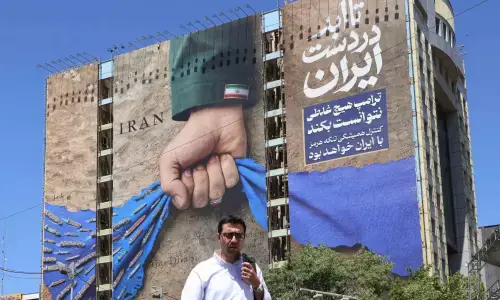
CHAGAI: Civilian and security officials from Pakistan and Iran discussed border mapping on Saturday during a follow-up meeting that came after Pakistan’s surveyor general visited the neighbouring country earlier this month.
Official sources privy to the meeting told Dawn on Sunday that a two-point agenda came under discussion during the meeting, attended by a six-member Iranian delegation headed by the country’s director general of border affairs.
The eight-member Pakistani delegation comprised officials from the army, Frontier Corps, the Survey of Pakistan mapping agency and Chagai Deputy Commissioner Mansoor Ahmed Baloch.
The follow-up meeting was held in Taftan, a town near the two countries’ border in Chagai district.
Officials review details of mapping surveys in a high-level meeting
A high-ranking officer, who attended the meeting and did not want to be named, told Dawn that the discussion was aimed at successfully completing fencing along the border.
The participants noted that a few border pillars disappeared in some parts and the issue needed to be identified and validated for fencing. “It should be clear that there’s no dispute on border fencing between Iran and Pakistan. In fact, the Iranian authorities welcomed border fencing while terming it a significant step to ensure security on both sides,” he said.
The details of previous joint surveys were presented in the meeting and the clarification of technical aspects of conduct modalities were discussed in detail.
It was agreed that aerial and ground mark of border pillars would be carried out to make detailed maps of the border zone. A four-kilometre strip — two kilometres on each side — would be mapped as per the protocol.
The officials also agreed that the 909-kilometre Pak-Iran border would be divided into four sections and each side would map two sections, with monitoring from both countries. It was also decided that each side would prepare a detailed plan and get it approved from their higher authorities concerned.
Meanwhile, Chagai’s deputy commissioner informed his Iranian counterpart about the problems being faced by local residents due to prolonged closure of Rahdari Gate from the Iranian side. Deputy Commissioner Baloch told Dawn that the gate was the only way for people who visit their relatives after getting a 15-day special permission to travel a limited area of both countries.
Published in Dawn, March 28th, 2022