ISLAMABAD: A task force of the European Organisation for Nuclear Research (CERN) is reviewing to extend the associate membership of Pakistan for another five years, a press release of the Pakistan Atomic Energy Commission (PAEC) said on Friday.
The task force comprising five experts is holding meetings with different entities in Pakistan to review the associate membership.
Pakistan’s five-year associate membership completed in July 2020. The CERN council designated a task force and decided to carry out a virtual review of the country’s membership from March 7 to 18 this year due to the Covid-19 pandemic.
However, one of the meetings was postponed due to the extraordinary call session of the CERN council on Russian-Ukraine conflict, the PAEC said. The postponed session will now be held on April 19.
Virtual meetings of CERN task force members with Pakistani delegates were held at length at PAEC headquarters. PAEC Chairman Muhammad Naeem welcomed all CERN task force members for virtual meetings with different entities in Pakistan and elaborated millstones of the collaboration.
Pakistan became a CERN associate member on July 31, 2015 and is contributing to its projects, including detector technology, heavy mechanical parts fabrication and providing technical support.
The PAEC is the lead agency for the Pak-CERN collaboration. Other institutes participating from Pakistan include NCP, COMSATS, PINSTECH and other universities.
CERN, one of the world’s largest and most respected centres for scientific research, was established by 20 European countries in Geneva on the principle of “science for peace”.
It has now evolved as the world’s largest particle physics laboratory with 23 members, 10 associate members and six observers.
CERN’s aim is to unravel the frontiers of knowledge and the secrets after the Big Bang, develop new technologies for accelerators and detectors, train scientists and engineers for future, and and unite people from different countries and cultures.
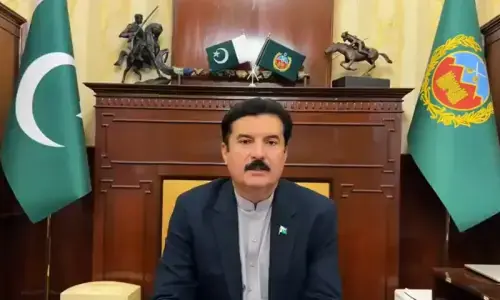
On March 18, CERN task force members also had a virtual meeting with Minister for Science and Technology Syed Shibli Faraz.
Mr Faraz appreciated the long-standing collaboration of Pakistan with CERN and particularly the increased cooperation after Pakistan attained the status of an associate member.
Pakistan has attained numerous benefits from the membership, such as increased number of engineering contracts to support CERN programmes, which are beneficial for the country’s industrial sector, human resources development and sharing of techniques and technology in key areas, besides numerous intellectual benefits.
Published in Dawn, March 26th, 2022