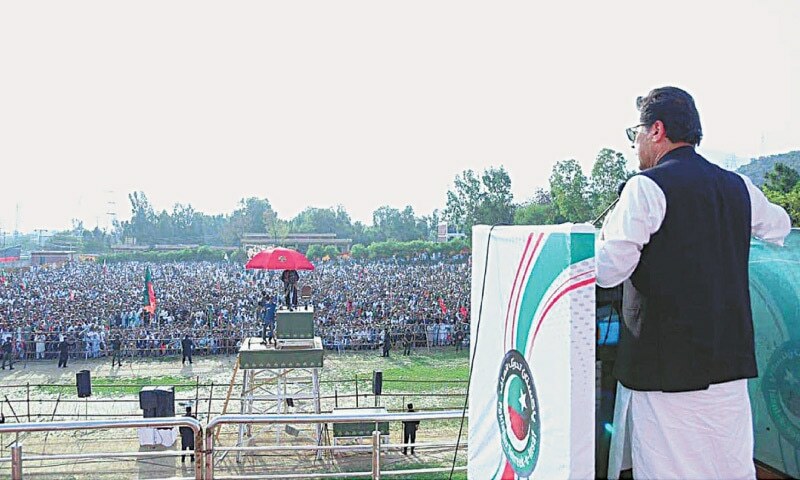
ECP issues notice to PM Imran for election code violation in Malakand

The Election Commission of Pakistan (ECP) on Sunday served a notice to Prime Minister Imran Khan for addressing a public gathering the same day in Malakand and told him to answer for violating the code of conduct issued for local body elections in Khyber Pakhtunkhwa.
In the notice, Malakand District Monitoring Officer (DMO) Ziaur Rahim directed the prime minister to appear before him or send in a lawyer on March 22 (tomorrow) at 10am for the purpose.
It said the premier had addressed the rally as part of the election campaign for PTI candidates for village councils and used state resources for the purpose.
The notice to the premier warned that if he failed to appear then "it will be presumed that you have nothing to offer in your defence and the matter shall be dealt with and decided under the law, rules and available record in your absence."
The DMO also issued notices to KP Chief Minister Mahmood Khan, Communications Minister Murad Saeed, Maritime Affairs Minister Ali Zaidi, Senator Faisal Javed, MNA Junaid Akbar, MPA Pir Musavir Shah and MPA Shakeel Khan for election code violation and directed them to explain their position on March 22.
This was the second ECP notice sent to the prime minister for a similar code violation in as many days. He was previously served a notice, along with other federal ministers, on March 11 for addressing a gathering in Lower Dir.
After receiving the ECP notices, the premier and Planning Minister Asad Umar had petitioned the Islamabad High Court (IHC), arguing that the ECP had issued notices despite new legislation regarding the election campaign. Last month, President Dr Arif Alvi had promulgated an ordinance amending the Elections Act and added Section 181(A) to it, allowing members of parliament, provincial assembly or elected members of local government to visit or address public meetings in “any area or constituency” before an election.
The court registrar’s office had then raised administrative objections to the petition, which were later removed by the prime minister and the petition was subsequently fixed for a hearing by Justice Aamer Farooq.
At the hearing on Friday, the IHC refused to issue an interim order to restrain the ECP from proceeding against the premier and federal ministers. It was of the view that the election commission had the constitutional mandate to devise a code of conduct to ensure free and fair elections despite the government lawyer's assertion that the ECP lacked jurisdiction to overrule the amendments introduced through an ordinance.
It is pertinent to mention here that earlier in the month, the ECP had dismissed the ordinance that amended the polling rules and barred key public office-holders, including the president and prime minister, from taking part in election campaigns.
According to the revised election code of conduct, public officeholders, including the president, prime minister, Senate chairman and deputy chairman, speaker and deputy speaker of any assembly, federal and provincial ministers, chief ministers, advisers, mayors, chairmen, nazims and their deputies will not participate in the election campaign of candidates in any manner. However, MNAs, MPAs and senators can participate in canvassing by strictly abiding by the code of conduct.
Malakand is one of the districts, where the second phase of local body elections will be held on March 31. Other districts include Abbottabad, Mansehra, Battagram, Torghar, Upper and Lower Kohistan, Kolai-Palas, Kohistan, Swat, Shangla, Upper and Lower Dir, Upper and Lower Chitral, Kurram, Orakzai, and North and South Waziristan.