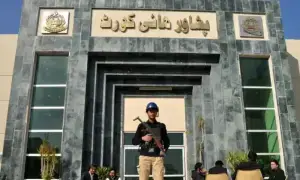
ISLAMABAD: The Islamabad High Court (IHC) chief justice on Thursday disposed of a petition seeking a ban on political gatherings before and during the voting on a no-confidence motion against the prime minister, but warned that the interior minister and his subordinates will be held accountant in case of any misadventure.
The petitioner — Islamabad resident Asma Malik — approached the IHC, asserting that the security of people living in the capital was at grave risk on account of the calls given by the political leaders to hold public meetings at D-Chowk in front of Parliament House.
Her counsel has argued that various political leaders, including those of the ruling party, had made statements that could incite violence, posing a risk to citizens and their properties.
The petitioner also attached with the petition copies of messages posted on social media by leaders belonging to both the ruling and opposition parties in support of her contention that they intended to create lawlessness and thus there existed an imminent and serious risk of harm to the citizens and their fundamental rights.
The ruling PTI has announced holding a million-strong gathering outside Parliament House in a bid to support its leader Imran Khan and to apparently deter the party’s lawmakers to cast votes.
The opposition alliance has also warned of flooding D-Chowk with their supporters ahead of voting on the no-confidence motion.
IHC Chief Justice Minallah termed this “an extraordinary situation” because the political party in power as well as those in the opposition had announced a show of their street power.
“It is, therefore, an onerous constitutional obligation of the executive authorities to strike a balance between the guaranteed fundamental rights, regardless of whether the applicant is from the ruling political party or represents those who sit on the opposition benches,” he advised.
Justice Minallah noted that maintaining public order and imposing reasonable restriction in the context of regulating under Article 16 of the Constitution was within the exclusive domain of the executive authorities, i.e. the interior minister, the interior secretary, and Islamabad’s chief commissioner, deputy commissioner and the inspector general of police (IGP).
“The aforementioned officials are, therefore, directed to ensure that while considering applications received from the political parties, they will be mindful of their constitutional duty to safeguard the fundamental rights of all the citizens. They obviously are equipped and competent to undertake an exercise to assess the likely risks and thereafter take such decisions as would be necessary for safeguarding the rights of the citizens,” he added.
Published in Dawn, March 18th, 2022