5
5

ISLAMABAD: Amid the confusion and contradictory positions from power companies, the National Electric Power Regulatory Authority (Nepra) remained undecided whether or not to pass on Rs28 billion additional burden to the consumers of Distribution Companies (Discos) of ex-Wapda.
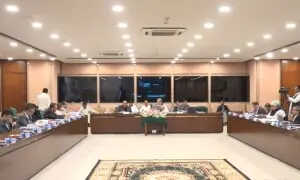
A public hearing presided over by Nepra chairman Tauseef. H. Farooqi finally directed the Discos to re-submit reconciled data on account of Rs28bn they wanted to charge consumers at the rate of 28 paise per unit on account of quarterly tariff adjustments for the first quarter (July-September) of the current fiscal year.
Interestingly, Nepra had earlier postponed the public hearing set for Jan 12 on similar considerations. The regulator also decided to seek the attention of the federal government towards the affairs of the Discos in writing and asked the secretary Power Division to sit with the management of Discos to see what they were doing.
Nepra also directed the Discos to submit in writing how they treated the industrial support package announced by the government as the top representative of the Central Power Purchasing Agency (CPPA) Rehan Akhtar conceded there was confusion. The power sector regulator said it was not possible for it to reach a conclusion unless data relating to all the aspects of tariff adjustments was available in writing on the table.
Orders power firms to submit reconciled data
During the public hearing, it came to light that various Discos had charged industrial support and incentive packages for other consumers. It was also not clear if and to what extent the government had provided subsidies against various discount packages.
The regulator raised questions relating to capacity charges on the units consumed under the Industrial Support Package.
Nepra vice-chairman Rafiq Shaikh said that the determined tariff of industrial support package was Rs12.96 per unit then why Discos had demanded capacity charges.
The hearing had been convened on quarterly adjustments demanded by Discos on account of capacity charges, transmission charges, financing cost, variable operation & maintenance charges, and impact of transmission and distribution losses on fuel charges for the first quarter of 2021-22.
Under the tariff mechanism, changes in fuel cost are passed on to consumers only on monthly basis through an automatic mechanism while quarterly tariff adjustments on account of variation in the power purchase price, capacity charges, variable operation and maintenance costs, use of system charges and including the impact of transmission and distribution losses are built in the base tariff by the federal government.
Published in Dawn, February 24th, 2022