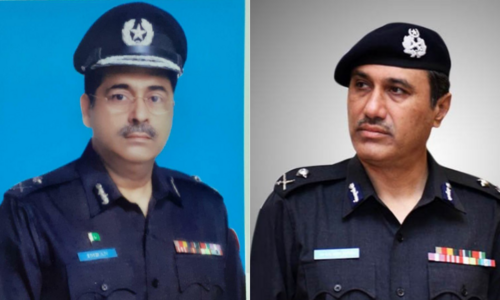
KARACHI’S senior police leadership was recently reshuffled following concerns about rising street crimes. The move comes in a bid to compel Sindh’s security administration to control this pattern of offending.
Street crime is a broad category that refers to multiple crimes, such as house robberies, pickpocketing, drug trade, etc. It can extend both to public and private spaces. Some of these crimes are born out of opportunity, others out of necessity. Each crime type requires context-specific responses, though they may be analysed collectively.
Citizens wonder why the 2013 Karachi operation failed to curb this form of criminality. This is because dismantling terrorist groups, militant wings, or armed gangs can temporarily reduce specific types of violent crimes (although recent attacks may call these successes into question). However, street crime is a different challenge linked to broader socioeconomic issues. Indeed, some street criminals have previously been connected to groups engaging in religious or political militancy, but the latter’s decline is unlikely to disrupt the former.
Read more: Sindh CM attributes rise in Karachi street crimes to 'financial situation' of country
Policing, performed through public or private forces, is a limited response to street crime. At most, we can deploy more resources to certain areas, for hotspot policing, deterrence, or intelligence-collection. Such securitised responses may reduce crime in selected areas, but they cannot stop people from offending. Security deployment is a form of target hardening which is reactive, not preventive. It can also lead to punitive and populist penal policies.
Policing is a limited response to street crime.
Prevention requires targeting structural problems in a society, such as income inequality, unemployment, class-based discrimination, and a lack of political representation and empowerment of the working class. This is only possible when all stakeholders come together and have their needs heard and addressed, especially grassroot organisations fighting for the basic rights of the most marginalised — their right to housing, water, work, protest.
Our sociopolitical structures and ruling elite do not have the appetite for this; they offer short-sighted, reductive and classist crime-control solutions, such as criminalising beggars and shunting them from affluent residential areas. This risks further marginalising entire communities most vulnerable to violent crime.
They also romanticise the zero-tolerance policing styles of the 1990s, as seen in New York City when crime rates were brought down. They forget to mention that this could not have been possible without other significant changes taking place in political, judicial and infrastructural spheres, and in healthcare, to improve urban life.
We must also consider that where there are structural problems in a society (such as economic disparity), and there are institutional problems within the police (such as underpaid officers), you will have a natural collusion between police officers and criminals. Karachi is no exception.
Read more: Karachi cop kills himself to avoid arrest for murder: police
Street cops rely on maintaining relations with local criminals (which is not always prohibited by the higher ups), because they cannot get their needs met by their menial salaries alone. If most officers are underpaid, they will strategically consider means of supplementing their income. Such collusion may also help recruit potential informants. In other words, where there are criminals, there will also be the police; expecting a neat divide in this relationship ignores the messiness of policing Pakistan’s streets.
While I hesitate to compare policing in developed and developing contexts, a relevant observation can be made from recent events surrounding the unceremonious ouster of London’s police commissioner. Touted for following a ‘policing by consent’ model, the Met Police has suffered repeated allegations of institutional racism, sexism, corruption and a misogynistic police culture. While the commissioner’s departure is celebrated, analysts caution that the chief’s removal is unlikely to address deep-rooted structural problems in the police.
Similarly, leadership changes within Pakistani police forces are often cosmetic and superficial responses. These manoeuvres enable police administration to show that something is being done, while still leaving the force open to criticism and blame when crime escalates, and insecurity intensifies. The brunt of this blame is directed at lower-ranked officers whose complex existence is uncritically problematised as ‘thana culture’.
In short, street crimes and similar offences cannot be addressed by security administrators alone. These are not ‘crises’ to be ‘policed’, but symptoms of deep-rooted grievances, both within and outside the institution of the police. To therefore frame this as a ‘policing’ problem or a security challenge, necessitating a so-called ‘war on street crime’, diverts attention from faulty governance and unfulfilled political promises.
The writer is an assistant professor at the University of Warwick.
Published in Dawn, February 20th, 2022