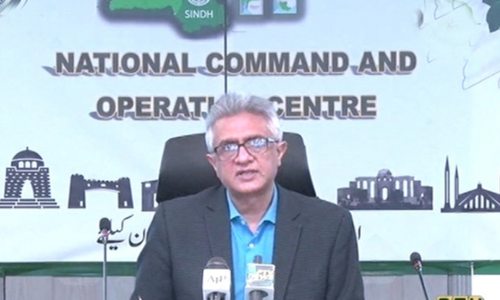
The National Command and Operation Centre (NCOC) on Monday decided to ease restrictions on the number of people allowed to attend matches during the upcoming Lahore leg of the Pakistan Super League (PSL) 2022.
In a statement, the NCOC said it has given the Pakistan Cricket Board (PCB) the go-ahead to allow spectators up to 50pc of the stadium's capacity in matches till February 15 while 100pc crowd occupancy has been allowed from February 16 onwards.
Previously, the NCOC had allowed up to 25pc occupancy during the Karachi leg of the tournament.
The spectators must be fully vaccinated, the NCOC said, adding that unvaccinated children under 12 years of age would also be allowed.
The decision was taken in an NCOC meeting chaired by Planning Minister Asad Umar which discussed epidemic data, national vaccination progress, inbound health protocols and the second phase of the ongoing PSL.
RAT for inbound passengers
In its meeting today, the NCOC also decided that Rapid Antigen Testing (RAT) for inbound passengers on arrival at Pakistani airports would be abolished from Tuesday.
"RAT test will continue to be conducted for deportees from foreign countries and for non-vaccinated individuals arriving from land border terminals," the forum said.
The decisions come amid an improving coronavirus situation with infections falling and the positivity rate declining.
Pakistan reported 3,338 new coronavirus cases in the last 24 hours, down from 4,874 a day earlier. It marked the second straight day that less than 5,000 infections were confirmed.
Meanwhile, the national positivity rate stood at 7.5pc. It has remained below 10pc for a week.
"After a sudden spike in cases, the graph has straightened, but we cannot say that the wave has declined. It has happened due to five reasons or steps taken by the government from the platform of the NCOC," Special Assistant to the Prime Minister on Health Dr Faisal Sultan told Dawn last week.
"The first reason is that every pandemic has a natural cycle and it declines after some time. Other factors are steps taken by NCOC, such as [a] ban on indoor weddings that had become a major cause of the spread of [the] virus. Other reasons included segregated classes in educational institutions and curbs in other sectors, such as transport," he said.