GAMBAT: The Gambat Institute of Medical Sciences (GIMS) has today become the best healthcare facility of the country offering 100pc free treatment for liver, kidney, bone marrow and cancer diseases.
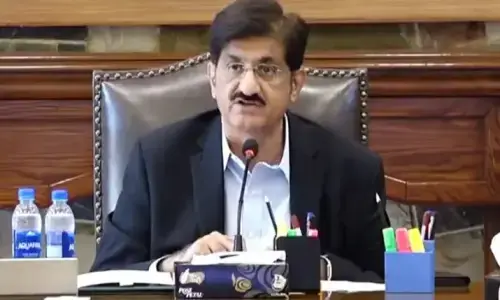
This was stated by Pakistan Peoples Party (PPP) chairman Bilawal Bhutto-Zardari while addressing a ceremony held here on Friday for the inauguration of the ‘Bone Marrow Transplant Institute’ established on GIMS premises, says a press release issued by the party.
He challenged all other provincial governments to come up with a hospital like GIMS having all these free-of-cost treatment facilities, and declared Gambat the ‘medial capital of Pakistan’.
He expressed his joy over Sindh’s advancement in the healthcare sector and said his vision was to ensure availability of free healthcare facilities in all parts of the country.
Declares Gambat ‘medical capital of Pakistan’
Mr Bhutto-Zardari told the audience that keeping in view a rising number of road accidents and emergencies like fire etc, a ‘rapid response emergency centre’ was also launched. Establishing such centres in other cities was also under consideration so that people could get timely medical assistance in the best possible way in case of emergencies, he said.
The PPP chairman cut a cake to celebrate Sindh’s achievement of breaking the national record by performing 550 free liver transplants. Among these cases, he noted, 52pc belonged to Sindh, 29pc to Punjab, 15pc to Balochistan and 3pc belonged to Khyber Pakhtunkhwa. “Punjab has a liver and kidney institute that performs transplants as well but the number of people from that province treated at GIMS for such diseases is higher than the overall patients treated at the institute in their own province,” he noted.
He said PPP wanted healthcare to be completely free so that no one was deprived of medical treatment due to a lack of money. “To meet our goal, we have made heavy investments, especially in tertiary care hospitals,” he added.
PTI’s health card
Mr Bhutto Zardari said that when PPP had formed its government, it had introduced the ‘Waseela-e-Sehat Card’ to help the poor; when PML-N came to power, Mian Sahib [Nawaz Sharif] changed its name to ‘PM Health Card’; and now PTI was calling it the ‘Sehat Insaaf Card’. “But you need wisdom to even copy a bright idea,” he remarked.
The way they [PTI people] are running our card is wrong,” he said, and pointed out: “We offered it to the poor whereas their card offers a subsidy of Rs500,000 to Rs600,000 to private hospitals”.
He said the “selected” government could run the healthcare sector better if some of this money was given to the poor and the rest was utilised in the budget of government hospitals.
“The budget of only three Sindh government institutions — GIMS, SIUT (Sindh Institute of Urology and Transplant) and NICVD (National Institute of Cardiovascular Diseases) — is bigger than the budget of the entire Khyber Pakhtunkhwa health card,” he claimed.
The PPP chairman described PTI’s health card as “a theft of the health budget”, arguing that this money would be given to private insurance companies.
Published in Dawn, January 29th, 2022