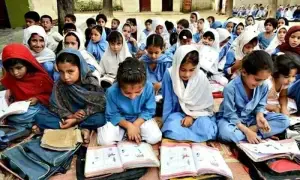
Each year, on the annual children’s day observed on Nov 20, countries around the world make pledges and promises to ensure protection and provision of basic rights to children who remain the most neglected section of the population in most regions.
Across Pakistan also, awareness seminars are held and calls are made to enact legislation or for strict implementation of laws; a country where children remain the most abused section of society and no law has been able to contain this menace. According to the Cruel Numbers report compiled by Sahil, 2,960 cases of child abuse were reported from all over the country in 2020, showing an increase of four per cent from the previous year wherein Punjab accounted for the highest number of cases of 1,707.
On the 2021 World’s Children Day, the Pakistani leadership once again resolved to protect children from exploitation, exclusion and marginalisation. In the face of all these pledges and resolutions, ironically, it has come to light that most of the child protection laws in Punjab lack rules of business despite the legislation having been enacted over a decade ago in some cases – a fact that the political leadership of the province admits to.
The Punjab Destitute and Neglected Children Act was enacted in 2004, but its rules of business have yet to be framed. Similarly, no rules have been devised for the Punjab Free and Compulsory Education Act of 2014 or the 2016 Punjab Prohibition of Child Labour at Brick Kilns Act.
After decades of lack of firm policy, govt claims working on all-encompassing draft
Moreover, under the 18thamendment, all provinces were meant to formulate a child protection policy, but multiple attempts at it have failed since then. There is a need for an institutionalised mechanism or guidance policy the absence of which has resulted in confusion and lack of coordination among public departments as to who is to look after child protection.
Punjab Social Welfare and Baitul Maal Minister Yawar Abbas Bukhari acknowledges that there is an urgent need for a child protection policy and while there were several laws, there was little or no implementation. To do away with any confusion about the role of various departments in child protection and avoid any conflict among the various laws, the minister revealed a new comprehensive, multi-sectoral law was being drafted combining the functions of all relevant sectors, including social welfare, child protection, labour, education, prosecution and law.
Child Protection and Welfare Bureau (CPWB) Chairperson Sarah Ahmad, however, claims that when she took over the bureau three years ago, there was, in fact, a draft child protection policy prepared in consultation with Unicef, but wasn’t concrete enough. “We then started work on a policy afresh and faced several obstacles, but now a new draft has been prepared solely by the bureau.”
While the scope of the destitute and neglected children law was limited and dealt with protection only, the new all-encompassing legislation will cover welfare also. Explaining its contours, Minister Bukhari told Dawn: “All child protection laws, barring labour, will stand repealed and be represented in some way in the new law that will explain the definitions of a child and child rights, tackle child rehabilitation, entail strict penalties for any kind of harassment or abuse: physical, nutritional, educational or sexual.”
On why underage labour hasn’t been covered, he explained that labour and social welfare departments will be in liaison with each other for the implementation of the new law, which will end up strengthening and supporting the labour laws to protect children.
But Ms Ahmad refuses to admit the Punjab Destitute and Neglected Children Act 2004 is limited in any way and stresses it’s sufficient to handle all kinds of violence against children. “We follow the PDNC Act that covers everything. We intervene in child abuse and torture cases. So the bureau is taking action and rescuing all sorts of children. It’s working according to the rules of the law.”
The laws already enacted are found to lack preventive measures and do not include the role of parents, teachers, religious leaders, community elders, NGOs that affect social and behavioural changes. Mr Bukhari claims the legislation in the works will feature an implementation apparatus where the public will be able to help the government. “We are working on how to incorporate this for public outreach.”
He expected the draft to be framed within a month. “There are some delays at the bureau’s end, but by the end of January we should be ready to send it to the cabinet and the assembly.”
Civil society and non-governmental organisations working for the protection of children complain that while the CPWB has made some strides, its legal mandate is still limited. They say it covers destitute, beggars, lost, runaway children, but not corporal punishment, child labour and abuse, hence the need for a comprehensive law.
Ms Ahmad, however, says the bureau just doesn’t cover child marriages. “We’re working on this aspect and minor amendments that we need to add to the PDNC Act. A new draft policy has been prepared, which is going to be sent to the line departments and all stakeholders for their feedback. A summary will be sent to the home and law departments and it will then be placed before the cabinet.”
Talking about expansion of the bureau, she explained it was already present in eight districts of Punjab and its functions would start in Sargodha, Dera Ghazi Khan and Sahiwal within this year. She added that construction of a bureau in Kasur had begun where it was direly needed being the hub of child pornography and abuse. “We will be present in all 36 districts in the next two years to rescue children subjected to any kind of abuse, violence, abandonment or neglect.”
Human Rights Minister Ejaz Alam Augustine believes prevention of child labour is a moral responsibility more than a lack of implementation of laws, starting from affluent households. “No state has the means to check which house has employed child workers; it’s a moral responsibility and if we are morally strong we’d be able to eliminate child labour. We will all have to take revolutionary steps and work together with the civil society, state, religious parties to decide against inducting children, otherwise laws will be made and nobody will bother about them. More than laws we need to strengthen society.”
Published in Dawn, January 7th, 2022