KARACHI: Despite a strong protest by opposition parties in the province and the refusal by the governor to sign the legislation passed by the provincial assembly, the Sindh Local Government (Amendment) Bill 2021 is finally going to become a law on Thursday (tomorrow) indicating further escalation in the opposition’s ongoing campaign against the provincial government of Pakistan Peoples Party (PPP).
An official confirmed that Sindh Governor Imran Ismail once again while raising several objections had refused to give his assent to the recently passed bill.
The LG bill, which has been termed a black law by almost all opposition parties, was first passed by the assembly last month. As per constitutional requirement, the bill was sent to the Sindh governor for his assent. However, he returned the legislation with some 10 objections to the assembly for reconsideration.
Governor refuses to give his assent to fresh legislation; meets PSP, MQM delegations
On Dec 11, the ruling party had addressed some of the objections raised by the governor, including removing a clause that allowed election of mayor/chairman through secret ballot and reviving a condition that only an elected LG representative can contest the mayoral election when it got passed the LG bill again.
However, the provincial government had refused to return the functions of health and education to municipalities that it in the words of opposition had ‘snatched’ from the local governments and passed the bill, which was sent to the governor again for his assent.
According to Article 116 of the Constitution: “When the Governor has returned a Bill to the Provincial Assembly, it shall be reconsidered by the provincial assembly and, if it is again passed, with or without amendment, by the provincial assembly, by the votes of majority of the members of the provincial assembly present and voting, it shall be again presented to the Governor and the Governor shall give his assent within 10 days, failing which such assent shall be deemed to have been given.
“When the Governor has assented or is deemed to have assented to a bill, it shall become law and be called an act of provincial assembly.”
With or without the governor’s assent, “After 12 days it [LG bill] will stand implemented automatically across the province,” said a spokesperson for Governor House.
Opposition parties’ meetings
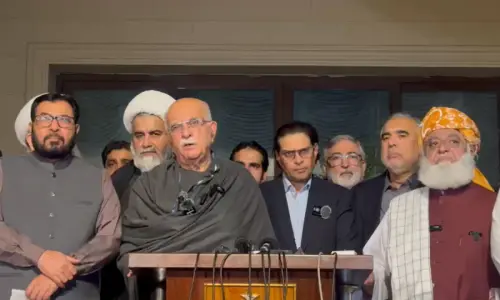
The fresh objection from the Sindh governor, though hardly matters what it would does, is the reaction from the opposition parties who have already started to consider uniting their separate movements.
In a fresh development even rival parties are considering joining hands on a single point agenda that demands strong LG system for Karachi and other parts of Sindh unlike the one proposed by the PPP government in the recently passed law.
The first move came from the Pak Sarzameen Party (PSP) and the Pakistan Tehreek-i-Insaf, which agreed on a mutual political agenda and admitted a recent thaw in their relations.
A PSP delegation led by former deputy mayor of Karachi Dr Arshad Vohra called on Governor Ismail in the presence of Leader of the Opposition in the Sindh Assembly Haleem Adil Sheikh. The two sides discussed issues pertaining to local governments and expected a situation that could emerge after implementation of the Sindh Local Govt (Amendment) Bill 2021.
They agreed on a joint struggle for ‘true’ democratic rights for the province and its cities and politics of tolerance instead of ethnicity and hatred.
“The two parties have witnessed recent thaw in their relations,” said Opposition Leader Sheikh while speaking to reporters along with PSP leaders after the meeting. “We believe that every democratic party, which believes in devolution of powers and a strong LG system, will sooner or later join hands in the larger interest of the people of Sindh.”
Dr Vohra of the PSP agreed with the PTI leader and said it was due to his party’s serious concerns over the law that it was approaching every political organisation which was in favour of a strong LG system in the province.
“We believe in the interest of people,” he said. “We came to the Sindh governor and PTI leaders only with a thought that there should be consensual and joint voice against this black law of the PPP.”
Both the PSP and PTI have already challenged the LG bill before the Sindh High Court through their separate petitions.
Later, a four-member delegation of the Muttahida Qaumi Movement-Pakistan (MQM-P) also met the Sindh governor.
A brief statement issued by Governor House said that the delegation, led by MQM-P convenor Dr Khalid Maqbool Siddiqui, held a detailed discussion with the governor.
“The two sides discussed their reservations over the local government law and federal government-funded projects in Karachi,” the statement added.
Published in Dawn, December 22nd, 2021