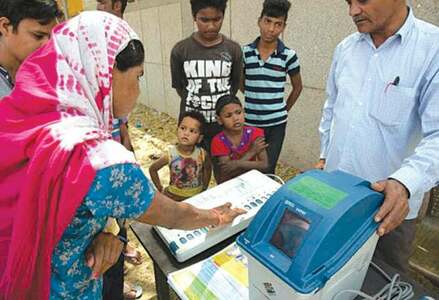
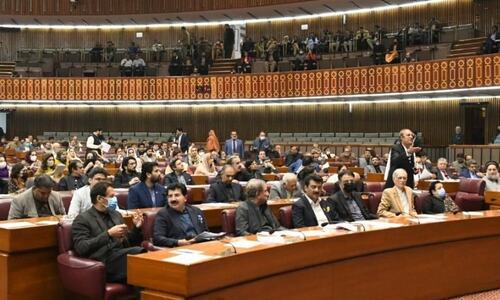
ON Nov 17, representative democracy received a blow perhaps even more profound than has been witnessed over the last three years. The pandemonium that prevailed during the joint session of parliament that day and the rhetoric following it has focused largely on two controversial amendments to the Election Act 2017. These pertain to the use of electronic voting machines and I-voting for overseas Pakistanis, contained in the Elections (Second Amendment) Bill, 2021, which the PTI government was desperate to pass despite the opposition’s vociferous objections and the ECP’s reservations.
Knowing it could only muster the required numbers — corralled with external help — in a joint session of parliament, the government decided to go for that option. While it is rightly being criticised on that score, what was the need to bulldoze the remaining 32 bills, some of which deal with extremely important issues and merit further input from stakeholders? Why jettison the entire process of debate and discussion that is central to well-considered lawmaking and which ultimately makes for more effective legislation?
Red Zone Files: The govt would have struggled in the joint session had it not received external support
The vast majority of the bills — 29, to be exact — that were enacted into law by the joint session had been passed by the National Assembly, and were in the Senate for deliberation. Article 70 of the Constitution provides for bills, under certain circumstances, to be considered in a joint sitting; it certainly does not envisage them being forced through in the roughshod way witnessed this week, without allowing for any meaningful debate or voting on the clauses contained therein that is required by the relevant rules of procedure.
No less than six bills pertained to Islamabad, including the Food Safety and Rent Restriction Amendment bills. Among the other bills were also the Criminal Law (Amendment) Bill, 2021, and the Anti-Rape (Investigation and Trial) Bill, 2021, stipulating the use of modern technology and setting up of special courts to investigate and try rape cases. These provisions to address the crime of rape had first been introduced through an ordinance in 2020, and were later tabled as proposed statutory legislation and passed by the Lower House.
Herein may lie the answer as to why the PTI government thought it fit to bring this massive legislative agenda to a single joint session of parliament. Time and again it has demonstrated an authoritarian streak that has little patience for parliamentary conventions and rules or the importance of having diverse points of view feed into lawmaking. That has translated into a plethora of legislation by executive decree during the last three years. Certainly, bypassing parliament is hardly the sole preserve of this government; ordinances are a convenient tool to avoid justifying proposed legislation to the opposition benches. But this week, the PTI government’s show of political expediency and its disdain for the grave responsibility of lawmaking offers yet more cause for alarm.
Published in Dawn, November 19th, 2021