ISLAMABAD: Prime Minister Imran Khan has said that fruits desired from the lawyers’ movement of 2007 “for independence of judiciary” were not achieved.
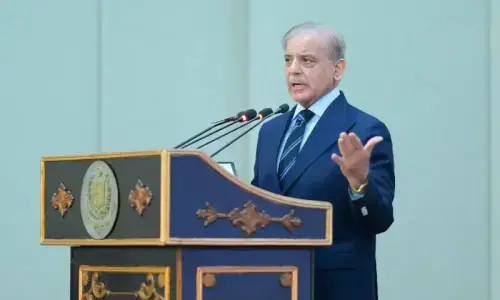
Speaking at the ground-breaking ceremony of the Islamabad District Courts’ building on Tuesday, he said that apart from violating the Constitution, retired Gen Pervez Musharraf had done the “greatest injustice” to the country by giving NRO to previous rulers.
“During the 2007 lawyers’ movement we told a military dictator that you can’t remove a chief justice like this. But I regret that the movement has not yielded the results that it should have,” he said.
“The struggle for the rule of law and justice is an ongoing process and society continuously strives for it. Whichever society establishes rule of law becomes prosperous and therefore I have been saying for 25 years that the country can only progress when the courts are free,” he added.
The prime minister said society became free when it got justice as justice was necessary to improve the life of the common man.
He said the government would provide better working conditions to the judiciary in order to ensure speedy justice for the public.
Mr Khan said the judicial complex comprising 93 district courts would facilitate all the stakeholders, including the bench, bar and the litigants.
He said that investment and development flowed into a country when the justice system provided protection and ensured contract enforcement.
The prime minister attributed Pakistan’s decline to the lack of rule of law.
He said overseas Pakistanis were the country’s biggest asset, but they were reluctant to funnel investment due to land-grabbers “flourishing” because of deficiencies in the legal system.
He praised Chief Justice of the Islamabad High Court Athar Minallah for his “fantastic judgements” which were important for society and the environment. “It has become a national necessity that we keep our country green, save our environment and keep our rivers and air clean.”
Mr Khan said a country could never progress where two separate streams of justice prevailed -- one for the powerful and other for weaker ones.
He pointed out that lingering litigation, particularly in cases of land-grabbing, was a big hurdle in the way to investment by overseas Pakistanis.
Speaking on the occasion, IHC Chief Justice Athar Minallah said access to inexpensive and speedy justice was the basic right of the people, which could be possible only “if all institutions continued to work within their ambits”.
“Supremacy of the law and the Constitution, and abiding by the oath of one’s office is a guarantee to justice and ensures the rights of the nation,” he said.
The chief justice said the goals of the 2007 movement were yet to be accomplished as its leaders had promised the masses a journey towards “a sate like a mother’, that protected and cared for its citizens.
The judicial complex, to be built by the Capital Development Authority (CDA) and Frontier Works Organisation in G-11/4 at a land measuring 195,000 sq ft, will be completed in six months.
The district courts have been functioning within a rented market at F-8 Markaz for the last 40 years with no reasonable facilities for judges, lawyers and litigants.
Earlier, CDA chairman Amer Ali Ahmed gave a briefing to the prime minister on the features of the judicial complex.
Law Minister Barrister Farogh Naseem, Interior Minister Sheikh Rashid Ahmed, Parliamentary Secretary for Law and Justice Maleeka Bokhari, judges and lawyers also attended the function.
Published in Dawn, September 8th, 2021