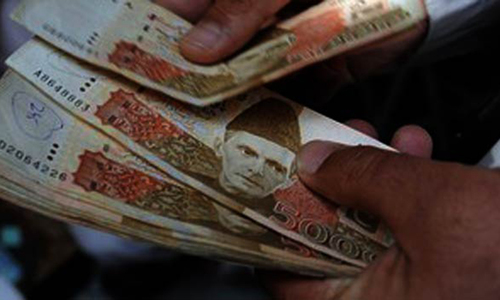
T-bills regain confidence of foreign investors


KARACHI: For the first time since the Covid-19 pandemic made its way to Pakistan in March 2020, the inflow of foreign investment in Treasury bills (T-bill) has surpassed the outflow in August despite a drastic cut in rates.
Latest data shared by the State Bank of Pakistan (SBP) shows the inflow of foreign investment in T-bills in the month up to August 16 reached $15.98 million against the outflow of $12.14m.
With the emergence of Covid19 in March 2020, foreign investment in T-bills and the Pakistan Investment Bonds (PIBs) flew back to its origin within a few months.
However, prior to the coronavirus pandemic, the inflows in the T-bills and PIBs were so rapid that these were termed ‘hot money’. The inflows reached about $3.5b within nine months since the government allowed foreign investment in domestic bonds in July 2019.
The flow of hot money suddenly increased in November 2019 for T-bills which attracted over $1 billion. The country received $1.078bn investment in T-bills from July 1 to mid-November. It finally reached around $3.5bn till March 2020.
The speedy inflows were mainly due to very high returns available for the investors. In the auction held on Nov 20, 2019, the returns on three-, six- and 12-month T-bills were 13.51pc, 13.28pc and 13.24pc, respectively.
These returns on T-bills were highly attractive compared to global offerings on bonds. The policy interest rate in Pakistan was 13.25pc in November 2019.
Following the emergence of Covid-19 in the country, the SBP drastically cut interest rates within a couple months from 13.25pc to 7pc and this is still being maintained to support the economy.
Despite the near 50pc cut in the returns on T-bills, foreign investors started buying short-term domestic bonds. In the latest auction held on August 12, the returns on three and six months T-bills were 7.24pc and 7.48pc, respectively.
The net inflows in T-bills during the first two months of the current fiscal year (FY22) were $79.5m while the cumulative outflows were slightly higher to $80.7m reflecting changing scenario for the domestic bonds.
The inflows in the domestic bonds were not coming from many countries before Covid-19 while the re-inflows are also limited to few countries.
Before the pandemic, inflows of investment for T-bills were particularly limited to three main countries including the United States of America (USA), the United Kingdom (UK) and the United Arab Emirates (UAE). The US invested $583 million in T-bills while the second highest investment was from the UK at $488.7m. Another significant investor was the UAE which parked $19.57m.
In FY22, the inflows for T-bills were $49.9m from UAE; $21m from UK and $8.2m from Singapore.
Pakistan Investment Bonds: Foreign investment also started joining PIBs as the inflows during FY22 were $16m while the outflow was $8.3m.
The trend shows that foreign investors are interested in short-term T-bills which allow them to sell out their holdings and leave the country within days or weeks.
Published in Dawn, August 19th, 2021