“Our battle is more full of names than yours,
Our men more perfect in the use of arms,
Our armour all as strong, our cause the best.
Then reason will our hearts should be as good.” — Shakespeare
‘MISSION accomplished’ was a phrase that came to haunt President George Bush for his two terms, even though he never used it. The two words were simply displayed on a banner behind him when he landed on an aircraft carrier in a flight suit to declare the end of major combat missions in Iraq. But that image and those words came to symbolise his failed and widely criticised Iraq policy as it was after this event that the violence in Iraq intensified, leading to heavy casualties on both sides.
President Joe Biden’s July speech where he said, in answer to a question, that the Taliban takeover of Afghanistan was not inevitable is going to reverberate similarly, for months and perhaps years to come.
But it is hard to believe that anyone expected the collapse of the Afghan army to be as sudden and as complete as it was.
In Islamabad itself, some of those who kept an eye on Afghan affairs felt its security forces would put up a challenge and slow down the Taliban. Even those who were more sceptical of the Afghan forces’ ability to hold (in hindsight a more realistic assessment) spoke of three to six months till the fall of Kabul. Perhaps most of us were letting the past colour our analyses — some referred to the difficulties the Taliban had controlling the entire country even after they took over Kabul in 1996 and some to the Najibullah government which lasted for three years after the Soviet troops departed.
Institution-building in Afghanistan was missing entirely as the soldiers were being trained.
But then history is not always a good guide to the future and when matters came to a head, the countdown to a Taliban takeover was merely days long.
And while there will be considerable focus on what is to come and if Taliban 2.0 will prove any different from the rule they provided in the 1990s, the quick collapse of the security forces will also inspire reams of paper and words in the days to come.
The videos on social media of Taliban fighters roaming the palatial residences of the fleeing officials and giggling at the plush surroundings brought to mind the Khaldunian warriors who are able to vanquish a decaying society used to a comfortable life.
But there is far more to this story.
At one level, it is yet again a reminder of the failure of the state building project — the impossibility perhaps of outsiders coming in to build a state, especially its military and turn it into a professional fighting force.
It seemed that in Iraq and in Afghanistan, the focus was on recruiting and training people but not on building institutions. Hence, corruption was endemic and career progression and accountability missing (the next time there is a story about the nonpayment of soldiers’ salaries, one needs to think about how and why the relevant government departments in Kabul were able to get away with this state of affairs for years).
Read: ‘Unfinished problem’: World leaders react to Taliban's reclaiming of Afghanistan
Partly, those training created forces dependent on their resources rather than what was possible indigenously — the US military developed a model in which its air support was a crucial factor for the Afghan forces. Hence as the widely read Wall Street Journal story on the quick collapse of the Afghan forces pointed out, once the American forces pulled out along with their airpower, the Afghan forces in far-off outposts could no longer hold on as supplies ran out. And this is one reason, says the story, the soldiers found it easier to surrender than to fight.
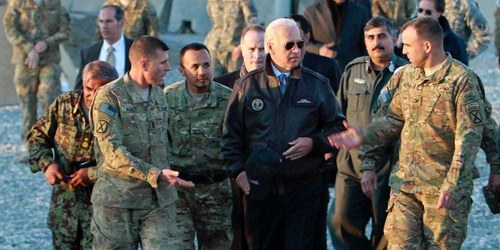
More importantly, institution-building was missing entirely as the soldiers were being trained — deliberately or otherwise — by the international forces. For there was constant talk of low morale — an easy term to bandy about but a complex one to unpack. It is linked to all that a professional outfit brings — merit, a sense of purpose and identification (which is inculcated in the institution) and a relationship with society. All this was missing in Iraq when the US-trained military collapsed in the face of the IS assault, and now in Afghanistan. Consider this quote from a paper on the Iraq army: “If the hallmark of professionalism is trust, the Iraqi army in 2014 did not have it: the people did not trust it and its members did not trust each other.”
That the agreement between the Americans and the Afghan Taliban increased violence against government installations and the people was also a factor. This too took its toll on the people and the regime.
But not all the blame can be laid at the door of the outsiders.
Ashraf Ghani and others around him in Kabul didn’t do much to win over their countrymen. If the north, which had evaded Taliban influence the last time, fell quickly it was partly due to its troubled relations with Kabul. Just recently in Badakhshan, government troops fired on protesters demanding water and electricity, reported the Washington Post. In Mazar-i-Sharif, in 2017, a governor was fired by Ghani, a move which nearly led to an armed conflict between the local militias and federal troops.
The fault lines and fissures were multiple but the presence of the superpower had papered over all of it. Once the forces’ withdrawal was finalised, there was a widespread — inside Afghanistan as well as internationally — sense of the inevitability of a Taliban takeover. Perhaps this simply convinced or hastened everyone to give up the fight rather than opting for resistance.
Indeed, as time passes, more details will be filled in, not just as to what happened in the districts and cities as the Taliban swept across the country but also what the regional powers were up to. In the latter category, Pakistan, especially, will not escape censure. But the internal failings are and will be the storyline, not just a chapter or two.
The writer is a journalist.
Published in Dawn, August 17th, 2021