Govt justifies buying expensive LNG to avert power tariff hike



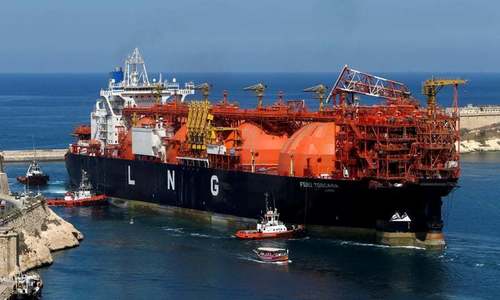
ISLAMABAD: The government on Friday conceded purchasing expensive liquefied natural gas (LNG) from the spot market as ‘a lesser evil’, saying no body without a crystal ball could perfectly time or beat international commodity market.
“Pakistan LNG Ltd (PLL) board was forced to accept the four LNG ‘spot’ tenders at $15 per mmBtu for September 2021; otherwise, the replacement fuel (ie furnace oil), which is even more expensive, would have resulted in September power prices higher by at least 20 per cent,” said a statement issued by the Petroleum Division.
The Petroleum Division and PLL had stopped making public the bid results after June 8 despite seeking, cancelling or accepting dozens of LNG bids, some of them even without normal tendering process. It had to confirm, however, media reports that some of the recent accepted bids had been highest so far.
Says no one can perfectly time or beat an international commodity market
The bids for four spot LNG deliveries in September accepted by the PLL ranged between $15.2 to $15.5 per mmBtu — the highest since the beginning of LNG imports in 2015. Interestingly, about eight bids for September and October were cancelled including those at $13.79 to $13.99 per mmbtu from Qatar as some other bids touched $16 and a single bid for PSO came in at $20 per mmbtu.
At a bid price of $15.5 per mmbtu delivered ex-ship, the sale price at the end distribution network would workout well above $20 per mmBtu. The Petroleum Division justified the higher prices on the grounds that “spot” LNG commodity price had spiked recently to over $15 per mmbtu due to a variety of supply-related issues like curtailment from Exxon’s facility in Papua New Guinea and demand-related factors like higher demand in China and Japan due to warmer weather.
It explained that roughly one-third of Pakistan’s monthly LNG purchases were on a “spot” basis and the remaining two-thirds on a long-term contract basis which was basically in line with global average for the LNG importing countries.
The ministry claimed that due to RLNG shortage, the government would have been forced to burn diesel to fulfil summer power demand and the resultant incremental electricity generation cost in September would have been almost 50pc more expensive. “So, it’s the lesser of the two evils”, said the petroleum division adding that if the country didn’t have enough RLNG in the system, the “opportunity cost” of forced gas load shedding for the industrial sector also had to be accounted for.
It said the crude oil prices were currently around $75 per barrel while the price of imported coal had also increased by almost 45pc since January this year. This showed the prices of most energy related commodities were on the upward trend due to higher demand and limited supply factors internationally as economies open up post Covid.
The Ministry of Energy went on to add that “no one, without a crystal ball, can perfectly time or beat an international commodity market” and there was no evidence-based correlation between the spot purchase timing (ie earlier or later) and the actual price of LNG as it varied (up and down) from time to time due to a host of demand-supply factors.
The ministry argued that as a matter of policy, Pakistan could opt for 100pc long-term contract purchases (either on a fixed per mmbtu or a fixed percentage of varying crude oil price), but even that would expose it to an “opportunity cost” should the spot prices fall at any stage due to any number of reasons.
Meanwhile, the Oil and Gas Regulatory Authority (Ogra) said it had achieved a final milestone by issuing licences for construction and operation of pipeline, being the last leg of LNG supply chain, to Energas Terminal (Pvt) Ltd and Tabeer Energy (Pvt) Ltd for carrying out the desired regulated activities.
Earlier Ogra granted licences for LNG terminal with the capacity of 750-1,000 mmcfd each and sale of regasified liquefied natural gas (RLNG) licences. The regulator has processed these licences on a fast-track basis. “All licencing formalities have been completed in the minimum possible time enabling companies to install their facilities and bring RLNG in the country,” it said.
Once the licenced facilities are completed and made operational, Pakistan will have an additional supply of 1,500-2,000 mmcfd of natural gas for industrial and other customers. This activity will bring huge investment in RLNG sector, competition in the gas market, create new job opportunities directly and indirectly by operation of closed and new industries, thus play a vital role in economic boost of the country.
Published in Dawn, July 31st, 2021