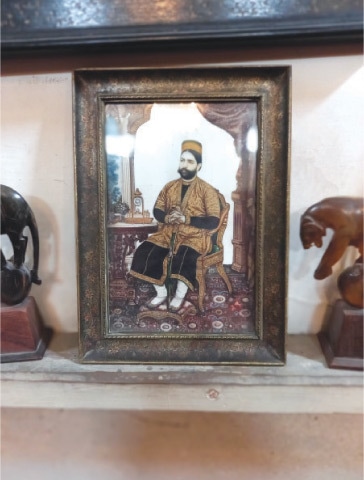
In the early 19th century, the great Mughal artist Ghulam Ali took 15 long years to paint a miniature portrait of Nawab Mumtaz Ali of Dajuna, using one hair of a squirrel.
The painting is so intricate and detailed that one needs a magnifying glass to truly recognise the veiled beauty of this piece of art exhibited by the Fakir family in their private museum inside the chaotic Bhati Gate of Lahore’s historic Walled City.
When looked through the glass, one can clearly see the Nawab’s oily hair strands. The Nawab can also be seen chewing a paan (betel leaf) while he was being painted. The wrinkles and the design of his wardrobe are also quite noticeable as the rest of the painting. This painting is only one of approximately 30,000 articles collected and preserved by the Fakir family in their museum.
Tucked away in a narrow Bhati Gate street, the museum is a peak into the glorious past of the region, managed currently by the seventh generation of the Fakir family. This family of hakeems moved to Lahore into the haveli of Raja Todar Mal, who was the finance minister of Emperor Akbar and laid the foundations of land records in the subcontinent, in the 1730s from Chunian during the downfall of the Mughal empire.
Upon entering the museum, one is welcomed by a large collection of paintings in what is called the miniature hall and, according to custodian Fakir Syed Saifuddin, is the heart of the museum. There are many masterpieces on display here, besides the miniature portrait of Nawab Mumtaz. Another masterpiece is the ivory painting of Mariam Zamani, one of Akbar’s wives.
From here, an alley leads to a hall displaying the Gandhara art on walls and in wooden showcases, dating back to the time of emperor Ashoka of the Mauryan dynasty of India. This art narrates the stories of Lord Buddha and what he went through. Right next to this collection lays a unique object: an ancient water filter with a depression in it that functions on the principles of reverse osmosis to filter water.
A shelf covered with locked wooden doors holds terracotta dolls dating back to around 7,000BC from Mehrgarh. As you walk along, you can’t help but notice the delicate 600-year-old egg shell china crockery adorned with gold paint, safely placed in a glass showcase. In the same hall is placed one of the rarest items in the museum, a ring of King Porus, who fought against Alexander the Great in India. Other rather unique couple of articles includes the Chinese poison plates that change colour or crack when filled with poisonous food.
After the Fakirs settled here, they set up a hospital, a pharmacy, a publishing house and a school. When Ranjit Singh came to power, Fakir Syed Azizuddin became the chief secretary as well as the foreign minister, while Fakir Syed Mohiuddin became Singh’s spiritual teacher. This is because the Fakirs were among the most affluent families in Lahore.
Over the years, the family kept collecting bits and pieces from various eras, some of which were also gifted to them by the East India Company due to Mr Azizuddin’s friendly relations with the British. The entire collection was transferred to the Lahore Museum when it was established in 1864. But it was later retrieved by the great grandfather of the current custodian of the museum, Mr Saifuddin, and a part of their residential haveli was converted into the Fakir Khana Museum that was opened to the public in 1905.
Touted by some as the largest privately owned museum in South Asia, it primarily features three centuries of art: 18th to 20th though it does display artifacts dating way before that time.
“The richest collection is the Islamic collection. It is in two sections: one is the Islamic relics that include 47 personal belongings of Prophet Muhammad (Peace be upon him), his family, companions and his descendants. These pieces are displayed here annually in Muharram and for the rest of the year are kept in a shrine, Darbar-i-Hussaini. The second Islamic collection includes handwritten copies of the holy Quran, calligraphic pieces by maestros and an overcoat given by the Sufi mystic and scholar, Ibn Arabi, to Ertugrul, the founder of the Ottoman Empire. This section also includes a piece of atlas silk bearing the signatures of a lot of Sufi saints and scholars,” Mr Saifuddin explains.
Visitors – sometimes in groups -- belong to all walks of life such as diplomats, students, tourists and artists. One could walk into the museum before the coronavirus pandemic hit, but now needs a prior appointment, says the custodian, as it is their residence also. He claims approximately 13,000 to 15,000 people visit the museum each year, and it is often offered for private events such as weddings, fashion shoots and family functions.
Housing thousands of other priceless and rare objects, this private museum -- the only one in the country apparently recognised and provided meagre funds by the government -- merits a visit to truly witness what the centuries gone by signified in terms of art, heritage and history.
Published in Dawn, July 25th, 2021