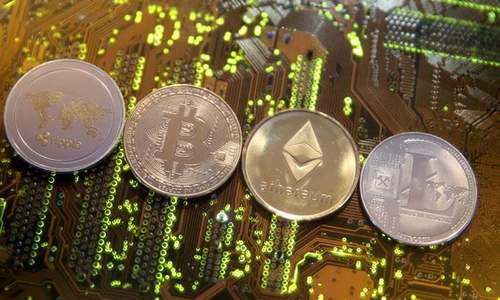
Pakistan moves to bring cryptocurrency boom out of the dark


ISLAMABAD: Once a week Ghulam Ahmed, 38, takes time out from his cryptocurrency consulting business to log into a WhatsApp group with hundreds of members eager to learn how to mine and trade cryptocurrency in Pakistan.
From housewives looking to earn a side income to wealthy investors wanting to buy cryptomining hardware, many barely understand traditional stock markets but all are eager to cash in.
“When I open the session for questions, there’s a flood of messages, and I spend hours answering them, teaching them basic things about cryptocurrency,” said Ahmed, 38, who quit his job in 2014, believing it was more profitable to mine Bitcoin.
Pakistan has seen a boom in trading and mining cryptocurrency, with interest proliferating in thousands of views of related videos on social media and transactions on online exchanges.
FATF has asked govt to better regulate the cryptocurrency industry
While cryptocurrency is not illegal in Pakistan, the global money laundering watchdog, the Financial Action Task Force (FATF), has called on the government to better regulate the industry. Pakistan is on the FATF’s grey list of countries it monitors for failing to check terror financing and money laundering.
In response, the federal government has set up a committee to study cryptocurrency regulation, which includes observers from the FATF, federal ministers, and heads of the country’s intelligence agencies.
“Half the members had no clue what it was and didn’t even want to understand it,” said committee member Ali Farid Khwaja, a partner at Oxford Frontier Capital and chairman of KASB Securities, a stock brokerage in Karachi. “But the good thing is someone set up this committee. The relevant bodies in the government who need to get things done are supporting it, and the promising thing is nobody wants to stand in the way of technical innovation.”
The head of the country’s central bank, Reza Baqir, said in April the authority was studying cryptocurrencies and their potential for bringing transactions happening off the books into a regulatory framework.
“We hope to be able to make some announcement on that in the coming months,” he told CNN. Baqir declined to comment to Reuters on the topic.
Even the education sector has caught on.
In February, one of the country’s leading universities, the Lahore University of Management Sciences, received a grant worth $4.1 million to study the technology from Stacks, a blockchain network that connects Bitcoin to apps and smart contracts.
Legalisation and Investment
These moves can’t come soon enough for cryptocurrency advocates.
Institutions have at times treated those involved in the trade of cryptocurrency with suspicion, worried about possible associations with money laundering.
Ahmed said he has been arrested by the Federal Investigation Agency (FIA) and charged with money laundering and electronic fraud twice, though the charges have not held up in court.
On one occasion, he said, the FIA seized a cryptocurrency mining farm he had set up in Shangla, in Pakistan’s northern Khyber-Pakhtunkhwa province, which ran on its own hydroelectric power. The FIA did not respond to Reuters’ request for comment.
Waqar Zaka, a former TV host with more than a million followers on YouTube, has been lobbying officials for years to not only legalise the industry, but have the government invest in it. Zaka, like Ahmed, had set up a cryptocurrency mining farm running on hydroelectric power.
Now, Khyber-Pakhtunkhwa’s provincial government has tapped Zaka and Ahmed to be on a committee studying how it can profit from such ventures. In March, the group announced it was looking into setting up new mining farms using Zaka’s facility as a template.
Despite the challenges, Pakistan’s crypto boom shows no signs of stopping.
Pakistan-based social media groups explaining how to trade and mine cryptocurrency abound, some with tens of thousands of followers on Facebook. On YouTube, cryptocurrency videos in Urdu have been viewed hundreds of thousands of times.
Online cryptocurrency exchanges, most based outside Pakistan, like Localbitcoins.com, have hundreds of Pakistani traders listed, some with thousands of transactions.
Apps like Binance and Binomo, which track and trade cryptocurrency, have more downloads than some of the country’s largest banks’ apps, according to web analytics company SimilarWeb.
“You cannot stop crypto, so the sooner Pakistan regulates things and joins the rest of the world, the better,” Ahmed said.
Published in Dawn, July 17th, 2021