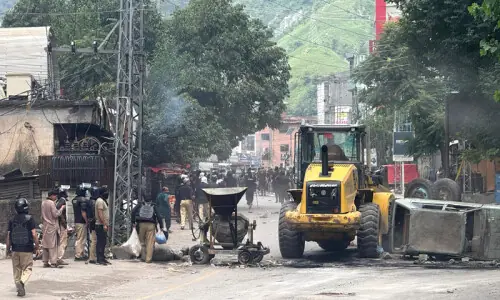
BAGHDAD, Oct 27: Nineteen people, including 17 Shia militiamen, died on Thursday in clashes near Baghdad with guerillas fighting the occupation forces. The clashes came as Sunni and Shia political groups jockeyed for position for the Dec 15 general election by pooling their respective forces into election alliances.
Militiamen from the Mehdi Army had asked police for backup in recovering a comrade who was being held in Al Khazaliyah, but the combined group was hit by guerillas as it prepared to launch the operation, an interior ministry source said.
The other two dead were policemen, while 12 militiamen were wounded.
The troubling upsurge in communal tensions came after US ambassador Zalmay Khalilzad said political progress could allow the United States to withdraw some of its troops next year.
“I do believe it’s possible that we could adjust our forces, downsizing them in the course of next year,” the US ambassador told journalists in Washington.
“That’s possible given the positive political developments and the continuing growth in the capabilities of the Iraqi forces.” US troops in Iraq currently number around 140,000.
RULING COALITION: Iraq’s ruling coalition, the United Iraqi Alliance (UIA), will contest December’s parliamentary election as a single electoral list, officials within the coalition said on Thursday.
Talks late into the night had resolved arguments that had threatened to break up the coalition, they said.
Among changes agreed, the movement of nationalist leader Moqtada al Sadr would have a more formal role in the alliance, officials said.
“The Sadr movement will have a clearer role in the list this time,” said Ali Dabagh, an Alliance member of parliament.
Parties and coalitions have until Friday to get their names on the ballot paper for the Dec 15 vote.
“The Alliance has reached a deal and they will go into the election with a full list,” Abbas al Bayati, another Alliance member of parliament, said.
“Almost everyone on the previous list is in.”
Three principle Shia parties are involved — the powerful Supreme Council for the Islamic Revolution in Iraq (SCIRI), formed in exile in Iran to oppose Saddam Hussein and led by Abdul Aziz al Hakim; the Dawa party of Prime Minister Ibrahim Jaafari; and Moqtada Sadr’s movement.
Although Moqtada Sadr has three allies in the present, interim cabinet, he has been ambivalent in public about the government. His armed supporters, the Mehdi Army, have clashed in recent months across southern Iraq with the Badr militia forces of Abdul Aziz Hakim’s SCIRI. –Reuters/AFP