India submerges unclaimed ashes of 1,200 Covid dead in farewell ritual

Published
Hindu priests leads the farewell ritual for hundreds of unclaimed clay urns containing the ashes of people who died from coronavirus. — AFP
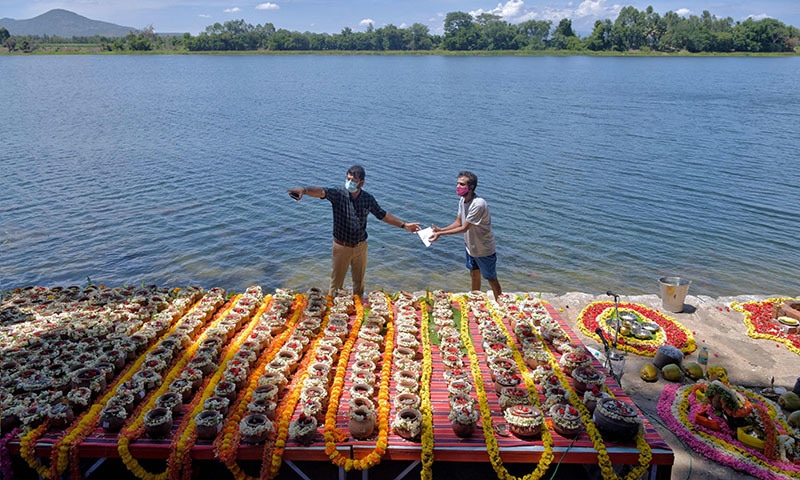
Hindu priests wait next to over 560 unclaimed clay urns containing ashes of people who died due to Covid-19 coronavirus on the banks of river Cauvery before a mass immersion ritual organised by the government of Karnataka, in Belakavadi Village in Mandya District situated about 125 Km from Bangalore on June 2, 2021. (Photo by Manjunath Kiran / AFP)
Over 560 unclaimed clay urns containing ashes of the deceased who died due to Covid-19 coronavirus disease are seen on the banks of river Cauvery before a mass immersion ritual organised by the government of Karnataka, in Belakavadi Village in Mandya District situated about 125 Km from Bangalore on June 2, 2021.
Municipal workers gestures next to over 560 unclaimed clay urns containing ashes of people who died due to Covid-19 coronavirus on the banks of river Cauvery before a mass immersion ritual organised by the government of Karnataka, in Belakavadi Village in Mandya District situated about 125 Km from Bangalore on June 2, 2021. (Photo by Manjunath Kiran / AFP)

Wrapped in white cloth and marked only by numbered stickers, dozens of clay pots lay unclaimed at the Sumanahalli crematorium in the suburbs of Bangalore, where the ashes of India's Covid dead have been piling up.

The urns were then transported for a mass riverside immersion ritual with the rest of the southeastern city's uncollected ashes on Wednesday — a total of 1,200 unaccounted virus victims.

The Hindu ceremony on the banks of the Cauvery River in the southern state of Karnataka comes as India battles a vicious second wave of infections that has killed 160,000 people in eight weeks, overwhelming the country's healthcare system and crematoriums.

In Hinduism, it is believed that immersing or scattering the ashes in the flowing waters of a river considered to be sacred liberates the soul of the deceased.

Hindu priests wait next to unclaimed clay urns containing ashes of people who died due to Covid-19 coronavirus on the banks of river Cauvery before a mass immersion ritual organised by the government of Karnataka, in Belakavadi Village in Mandya District situated about 125 Km from Bangalore on June 2, 2021. — AFP

But families have failed to come forward for hundreds of their relatives' ashes in Bangalore.

Some are too poor to carry out the rituals and others are scared of catching the virus at packed crematoriums where the pyres are burning without pause, workers say.

“In a family, two to three members might have succumbed to corona and some people fear contracting the infection so they don't want to take (the ashes),” Kiran Kumar, a contractor at Bangalore's T.R. Mills Crematorium, tells AFP.

That forced authorities anxious to dispose of the piling remains to take matters into their own hands, organising a ceremony led by Hindu priests and Karnataka state official R. Ashoka in Belakavadi village, located around 125 kilometres from Bangalore.

Before their immersion, the ashes were laid on a riverside platform, the clay pots sprinkled with red flowers and surrounded by garlands of yellow marigolds.

Unclaimed clay urns containing ashes of the deceased who died due to Covid-19 coronavirus disease are seen on the banks of river Cauvery before a mass immersion ritual organised by the government of Karnataka, in Belakavadi Village in Mandya District situated about 125 Km from Bangalore on June 2, 2021. — AFP

Ashoka, the state's revenue minister, dipped the first set of unclaimed ashes in the river.

Municipal workers placed the rest in a coracle, a small lightweight boat, and submerged the pots, in some cases without the knowledge of the grieving families who failed to collect them.
Opinion

Editorial

Quid pro quo
Updated 26 Jul, 2026

Quid pro quo

Accepting Israel would mean legitimising its violence against the Palestinians, as well as its neighbouring Arab states and Iran.
AI in government
26 Jul, 2026

AI in government

THE Prime Minister’s Office has announced the introduction of an AI-powered digital system and directed ministries...
Cautious optimism
26 Jul, 2026

Cautious optimism

THE latest polio surveillance figures offer some encouraging news regarding the difficult fight against polio. The...
Rampant lawlessness
Updated 25 Jul, 2026

Rampant lawlessness

THE brutal slaying of a judge and his guard in Mastung is the latest in a series of blood-drenched events that have...
Daily fuel pricing
25 Jul, 2026

Daily fuel pricing

THE government’s move to daily petroleum price adjustments should make fuel pricing more transparent and more...
The drug problem
25 Jul, 2026

The drug problem

WHILE Islamabad Police chase low-level peddlers, the capital’s kingpins have quietly taken their operations ...