Divestment of OGDC, PPL shelved over ‘low share price’

ISLAMABAD: The Cabinet Committee on Privatisation (CCoP) on Friday shelved the divestment of two state-owned blue-chip oil and gas producers due to high circular debt and adverse market conditions and allowed hiring of a financial advisory consortium to hand over all power distribution companies (Discos) to management contractors.
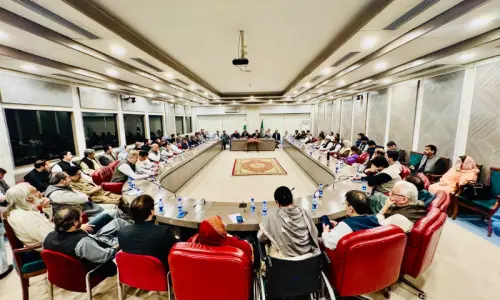
Finance Minister Shaukat Tarin presided over the CCoP meeting that decided that “divestment of shares is not feasible at this stage and should be considered only once issues like circular debt are resolved, even partially,” an official announcement stated. “Thereafter, strategic sale to a reputable exploration and development company should be a preferred option.”
The petroleum division of the Energy Ministry had opposed the divestment of 10 per cent shares of the Pakistan Petroleum Limited (PPL) and 7pc of the Oil and Gas Development Company Limited (OGDCL) because of low share price in the prevailing sluggish economic conditions.
The meeting was informed that the cabinet committee had allowed these transactions in August last year through public offering at stock exchanges. However, the petroleum division opposed the mode of transaction, saying both companies were profitable but current depressed share prices did not reflect their true worth because of adverse market conditions and high circular debt.
The division also reported that it had put on record in February last year that because of its depressed share price being traded at the stock exchange, the OGDCL’s 10pc shares should be offered to a strategic partner, preferably a petroleum exploration and development firm. This was suggested to take the company to a higher pedestal in terms of the best industry practices and knowledge, state-of-the-art exploration and production techniques in the larger interest of the company and exploration and production sector in Pakistan.
However, these recommendations for a strategic investor were not given any consideration while preparing for appointment of financial advisers. The petroleum division told the CCoP that current share prices of both the companies were depressed, as significant amount of current assets were stuck with the circular debt that has been increasing for years. As a result, the companies have not been able to pay dividends, thus undervaluing the shares.
By the end of January this year, the total receivables of OGDCL stood at Rs654 billion and that of PPL at Rs408bn. As a result, the price-to-earnings ratio of both the companies was very low as compared to the previous years and the current market multiples. It was reported for comparison that the P/E ratio of PPL currently stood at 4.8 when compared to 8.5 at the time of secondary public offering of PPL in 2014.
Also, the price-to-book ratio was less than one at present, indicating that the current market value of the company was less than its book value. Both the companies hold a significant number of exploration blocks thereby providing a further upside in case of discoveries.
Therefore, the petroleum division was of the view that any sale of shares should be only to a reputable international exploration and production firm with its representation through a board of directors so that a strategic partner could come up with new technologies, market insights and governance structures along with foreign direct investment. The CCoP agreed to the petroleum division’s stance.
The CCoP also approved a summary presented to the privatisation division for provision of funds for hiring of a Financial Advisory Consortium (FAC) of international repute having pertinent experience in the technical, financial, legal and regulatory fields to conduct the transaction of Discos and for carrying out an effective communication strategy effectively.
Under this strategy, five Punjab-based Discos — Lahore Electric Supply Company, Gujranwala Electric Power Company, Faisalabad Electric Supply Company and Multan Electric Power Company and Islamabad Electric Supply Company — would be placed under the private sector under a 10-year concession agreement to invest in aerial bundle cables, transformers and other equipment for loss reduction, improve governance and get return on investment.
The five loss-making Discos — Hyderabad Electric Supply Company, Sukkur Electric Power Company, Quetta Electric Supply Company, Peshawar Electric Supply Company and Tribal Electric Supply Company — were planned to be given to private investors on management contracts.
Published in Dawn, May 22nd, 2021