Govt will be forced to impose major restrictions if people don't follow SOPs: PM Imran

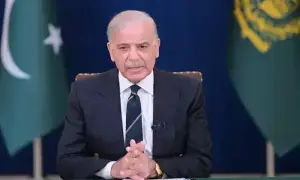
Prime Minister Imran Khan reiterated on Sunday that the third wave of the coronavirus was extremely dangerous in comparison to the previous two waves, urging the masses to strictly follow the standard operating procedures (SOPs).
Addressing the nation ahead of a question-and-answer session with the public, the premier cautioned that the government would be forced to impose major restrictions if people didn't start adhering to the Covid-19 guidelines.
"I have noticed ... people are not caring [and] are not taking precautions while going out in public," Imran said, warning that such an attitude could have dangerous consequences and lead to the spread of the disease.
"We have so far been protecting our people, we are not imposing a lockdown [or] closing our factories. We are only imposing minor restrictions so that this wave doesn't spread rapidly. But if this spreads, it will have a very negative impact and we will be forced to take steps."
Prime Minister Imran said the country could have plunged into a severe economic crisis if the government had imposed a lockdown for a second time. “Allah blessed Pakistan especially and saved us from the looming danger,” he added.
The premier said no one could predict with certainty how far the third virus wave would go.
“I request you to wear a mask wherever you go; it costs nothing and is highly beneficial, and the world has recognised its advantages,” he told the nation.
The premier noted that the most affected segment due to lockdowns were the poor across the world, saying according to an estimate 150 million people had gone below the poverty line in the wake of the closure of businesses and economies.
Ban on inter-provincial transport
Meanwhile on Sunday, National Command and Operation Centre (NCOC) announced a ban on inter-provincial transport for two days a week (Saturday and Sunday) with effect from April 10. The ban will stay in effect will April 25.
"Goods, freight, medical and other emergency services will be exempted," the statement issued by the NCOC said, adding that trains would continue to operate throughout the week at 70 per cent occupancy.
The ban will be reviewed by the NCOC on April 20.
With more than 4,700 daily Covid-19 cases confirmed on Saturday, the NCOC had issued guidelines for Ramazan, banning the entry of people older than 50 years and adolescents in mosques/imambargahs for prayers and advising the people to perform Aitikaf at home.
On March 31, Special Assistant to the Prime Minister (SAPM) on Health Dr Faisal Sultan had disclosed that 0.8 million doses of the Covid-19 vaccine had been administered in Pakistan, saying the campaign would be further sped up.